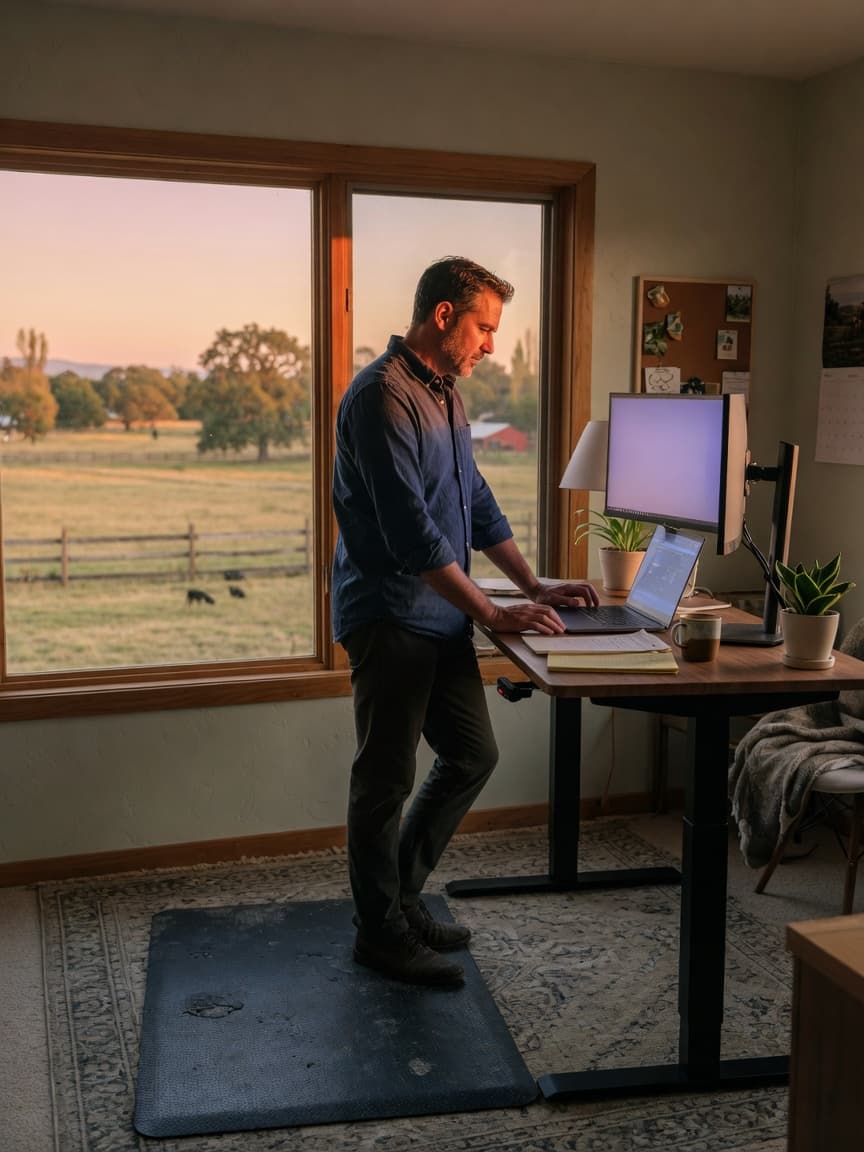
In the year 2000, at a Stanford conference on the future of artificial intelligence, one speaker said something the room could not take seriously.
While most of the researchers present assumed that human-level machine intelligence was a problem for the second half of the century — 2050 at the earliest, perhaps later, perhaps never in any form they would recognize — Ray Kurzweil stood up and named a date. Machines would match human intelligence, he said, by 2029.
He was regarded as an outlier. A talented inventor with a futurist hobby, extrapolating curves past the point where serious people were willing to follow.
Twenty-five years later, the heads of the world's leading AI laboratories routinely discuss systems reaching or exceeding human-level capability in the late 2020s or early 2030s. The median forecast of the field has quietly slid across two decades to arrive near the date Kurzweil named when almost no one agreed with him.
 View in GalleryRay Kurzweil presenting his 2029 timeline at a Stanford AI conference in 2000, while the assembled experts regard him with open skepticism.
This article is about that shift, and about the idea underneath it. Not the idea that one man was a prophet — he was not, and he got plenty wrong — but the idea that the shape and speed of technological change have been governed, for a very long time, by a pattern most people refuse to see. The singularity is the name we give to the place that pattern is pointing.
What follows is a map: where the idea came from, why the curve appears to be bending now, what the next two decades may feel like to live through, what "crossing" might mean, and what could lie on the other side — the good, the bad, and the genuinely strange. It closes with the harder questions: how to prepare, and the serious reasons the whole picture might still be wrong.
It is a companion to an earlier piece, The Shape of an Ordinary Day, which tried to imagine the texture of lived experience across this transition. This one is the argument beneath that imagining — the case for why the transition is coming at all, and coming faster than almost anyone is prepared for.
Part 1 — The Long History of the Idea#
Read in full
The word arrived late. The intuition arrived early.
A remark at Princeton#
The first recorded glimpse belongs to John von Neumann, the mathematician whose fingerprints are on the digital computer, game theory, and the hydrogen bomb. Sometime in the 1950s, in conversation with his colleague Stanislaw Ulam, von Neumann reportedly spoke of the "ever accelerating progress of technology" and a coming point beyond which "human affairs, as we know them, could not continue."
We know this only secondhand, through Ulam's later recollection. But the phrasing is striking. Decades before anyone had trained a neural network worth the name, one of the most powerful minds of the century had already sensed the essential thing: that progress was not linear, that it was compounding, and that compounding has a horizon.
 View in GalleryJohn von Neumann and Stanislaw Ulam in conversation at Princeton in the 1950s, sketching the first intuition of an accelerating technological horizon.
Good's explosion#
The idea acquired mechanism in 1965, when the British statistician I. J. Good — who had worked alongside Alan Turing at Bletchley Park — wrote a short, now-famous passage about what he called an "ultraintelligent machine."
The logic is almost unsettlingly simple. If we could build a machine that surpassed human intelligence even slightly, then one of the things it would be better at than us is building machines. It could design its successor. That successor, smarter still, could design a better one. Intelligence would become a self-feeding process. Good called the result an "intelligence explosion," and he added the line that has haunted the field ever since: the first ultraintelligent machine would be the last invention humanity ever needed to make — provided the machine was docile enough to tell us how to keep it under control.
 View in GalleryI. J. Good in 1965, writing by lamplight about the intelligence explosion — the idea that a machine smarter than us could design something smarter still.
That parenthetical — provided the machine is docile — is the entire field of AI safety in embryo. Good saw the upside and the trapdoor in the same sentence.
Vinge names it#
For nearly thirty years the idea drifted at the edges of science fiction and cybernetics without a proper name. Then, in 1993, the mathematician and novelist Vernor Vinge gave a talk and circulated an essay that fixed the term in place: the technological singularity.
Vinge borrowed the word from physics and mathematics, where a singularity is a point at which the known rules break down and predictions stop working — the center of a black hole, the divide-by-zero in an equation. His claim was blunt: within thirty years, he wrote, we would have the means to create superhuman intelligence, and shortly after, the human era would end. Not necessarily in catastrophe — but in opacity. Once intelligence greater than ours exists, the future becomes genuinely unpredictable, because it is being authored by minds we cannot model.
 View in GalleryVernor Vinge delivering his 1993 talk, fixing the term "technological singularity" into the language and warning that the future beyond it becomes unpredictable.
Vinge gave the concept its name and its sense of an event horizon — a line past which we cannot see. What he did not give it was a timetable you could defend with data.
Kurzweil's engine#
That is where Ray Kurzweil comes in, and why, fairly or not, the modern idea of the singularity bears his name more than anyone else's.
Kurzweil was not a pure theorist. He was an inventor with a long record of shipping things — reading machines for the blind, music synthesizers, speech recognition — and his futurism grew out of a practical habit: to ship at the right time, you have to predict where the technology will be in five years, not where it is today. Over decades of doing this, he claims to have noticed something. The improvement in information technologies was not just fast; it was exponential, and the exponent itself was remarkably stable across wildly different domains.
He generalized Moore's Law — the famous doubling of transistor density — into something far broader, which he called the Law of Accelerating Returns. The claim is that any technology that becomes an information technology starts riding a smooth exponential: not just computing, but genome sequencing, brain-scanning resolution, the cost of solar energy, the price-performance of communication. He documented these curves across the twentieth century in book after book — The Age of Intelligent Machines (1990), The Age of Spiritual Machines (1999), The Singularity Is Near (2005), and decades later the update The Singularity Is Nearer (2024).
 View in GalleryA young Ray Kurzweil in his workshop in the 1980s, surrounded by prototypes, tracing the exponential curves that would become the Law of Accelerating Returns.
Kurzweil's real innovation was to turn a mood into a model. Von Neumann had a feeling, Good had a mechanism, Vinge had a name and a warning. Kurzweil had a graph — a falsifiable, dated, quantitative claim about when the lines would cross. That is what made him testable. And being testable is exactly what made him, for twenty-five years, look ridiculous to his peers — right up until it didn't.
Part 2 — The Evidence: Why the Curve Is Bending Now#
Read in full
There are two ways to think about the future, and most people only have one of them.
The intuition gap#
The human mind is built for a linear world. Thirty steps forward is thirty paces — a walk across a field. We expect the next year to resemble the last one, plus a little. For almost all of human history this instinct served us well, because for almost all of human history change was close to linear.
Exponential change defeats this instinct completely. Thirty doublings forward is not thirty paces; it is a billion paces — roughly twenty-six times around the Earth. The first ten doublings feel like almost nothing. The curve hugs the floor. People glance at it, conclude "not much is happening," and go back to their lives. Then the curve reaches the steep part, and the same people who saw nothing for a decade suddenly feel like the world changed overnight. It didn't. It was changing at the same rate the whole time. They were simply standing on the flat part of an exponential and mistaking it for a flat line.
 View in GalleryA scientist confronting the same dataset two ways: as gentle, manageable linear progress, and as a curve that suddenly tears through the ceiling of the room.
This is the single most important idea in the article, and it explains nearly everything else. The reason Kurzweil looked absurd in 2000 is the same reason he looks prescient in 2026: almost everyone, including almost every expert, was reasoning linearly about an exponential process. They saw the flat part and called it the whole curve.
Kurzweil's predictions versus the consensus of his era#
Here is the contrast that the rest of this section is built around.
In The Age of Spiritual Machines, published in 1999, Kurzweil committed to specifics. By 2029, he wrote, a computer would pass a rigorous Turing Test — would, in conversation, be indistinguishable from a human and would claim to be conscious, and most people would come to accept the claim. By the same window, machine computation would rival the raw processing of the human brain. And the trajectory beyond that pointed to the singularity itself around 2045, a date he has barely moved in twenty-five years.
Now set that against what the field actually believed.
- At the 2000 Stanford conference, Kurzweil's 2029 figure was treated as the extreme edge of the distribution. The center of mass among serious researchers sat in the 2050–2100 range, and a substantial number considered human-level AI either centuries away or fundamentally impossible with any foreseeable approach.
- A poll of attendees at the 2009 AGI conference produced a median estimate for human-level machine intelligence around 2050, with a long tail stretching much later.
- Large surveys of machine-learning researchers conducted between roughly 2012 and 2021 repeatedly placed the median arrival of "high-level machine intelligence" somewhere in the 2040 to 2060 band — and a meaningful fraction of respondents answered "more than a century" or "never."
For two decades, in other words, the professional consensus was remarkably stable and remarkably far from Kurzweil. He was not slightly more aggressive than his peers. He was an outlier by twenty to fifty years.
 View in GalleryA split-screen timeline: the mainstream expert consensus clustered around 2050–2100, set against Kurzweil's lone exponential line pointing at 2029 and 2045.
Why the consensus was so conservative#
It is worth being fair to the skeptics, because their reasoning was not stupid. It was just linear.
Through the 2000s and 2010s, the dominant belief was that intelligence required insight — some deep conceptual breakthrough, a new theory of mind, that no one had yet found and no one expected soon. The prevailing paradigms (first symbolic AI, then early neural networks) had a long history of overpromising and underdelivering, and a generation of researchers had been trained to treat grand timelines as a mark of naivety. Above all, almost no one believed in scaling. The notion that you could get qualitatively new capabilities — reasoning, translation, coding, the appearance of understanding — simply by making the models larger and feeding them more data was, for years, treated as faintly embarrassing. Intelligence, surely, could not be that brute.
It turned out it could be, more than anyone expected. The skeptics were wrong not because they were foolish but because they were extrapolating in straight lines on log paper.
The reversal#
Then the curve hit the steep part, in public, all at once.
The release of GPT-3 in 2020 unsettled the field. The release of ChatGPT in late 2022 broke it open. Within roughly two years, systems existed that could hold fluent conversation, write working software, pass professional exams, and produce images and arguments that would have been classified as clear AGI by the standards of 2010. Capabilities that surveys had placed decades away were suddenly sitting on consumer laptops.
 View in GalleryA researcher from 2005 confronted with everyday 2025 AI — fluent conversation, working code, generated images — capabilities their own field had filed under "decades away."
The expert consensus did not so much update as capitulate. The leaders of the major frontier labs — the people with the most information and the most to lose from being wrong — began stating publicly that transformative AI or AGI was plausible within the 2026–2035 window. Forecasters who had spent careers in the conservative camp revised forward by decades. The median estimate of the field, which had sat near 2050 for a generation, slid toward the late 2020s in the space of about three years.
This is the crucial point, and it is easy to miss in the noise: the consensus moved to Kurzweil. Kurzweil did not move to the consensus. His 2029 date is essentially the date he named in 1999. The world spent twenty-five years walking across the flat part of the curve and arriving, startled, at the place he had marked on the map.
What this does and does not prove#
It does not prove Kurzweil is right about everything. He has missed, and missed badly, in places — several of his nanotechnology and medical timelines have slipped well past their dates, and "passes the Turing Test" is a slipperier milestone than it sounded in 1999. Being directionally right is not the same as being precisely right.
But on the single most important variable — the rate at which intelligence-related technology would improve — he was closer to the truth than the overwhelming majority of his professional peers, for more than twenty years, while they were closer to the truth than he was on essentially nothing that mattered. That is not luck. That is a better model.
And if the model is even roughly right, the implication is severe: the period between now and the mid-2040s will be more transformative than almost anyone — including almost every expert — is psychologically prepared for. We are not at the end of the curve. By Kurzweil's own framing, we are just now reaching the knee of it.
Many curves, one direction#
One last piece of the evidence. The singularity argument does not rest on AI alone. It rests on the claim that many exponentials are converging at once: computation, yes, but also the collapsing cost of genome sequencing, the resolution of brain imaging, the price-performance of solar energy and batteries, the maturation of robotics, and the early, real progress in brain–computer interfaces. Each of these is an information technology now, and each is riding its own version of the same curve. The argument is that they reinforce one another — better compute accelerates biology, better biology informs neuroscience, better neuroscience improves the interfaces between minds and machines — and that the compounding of compounding curves is what produces a true singularity rather than merely a fast century.
Part 3 — The Run-Up: The Next Fifteen to Twenty Years#
Read in full
The singularity is usually pictured as a single dramatic moment. It will be felt, far more, as an accelerating run-up — a couple of decades in which the ground shifts under everyone, faster each year, long before any threshold is formally crossed.
Phase transitions#
Expect the run-up to move through rough phases, each shorter than the last.
First, the age of agents — already beginning — in which AI shifts from a tool you prompt to a collaborator that acts: monitoring, drafting, researching, and executing across long horizons with limited supervision. Then a phase of genuine generality, where a single system handles essentially any cognitive task a capable human can, and the phrase "AGI" stops being a debate and becomes a product category. Then the first superhuman systems in narrow-but-critical domains — mathematics, programming, chip design, scientific modeling — that don't just match the best humans but exceed them, including at the task of improving AI itself.
That last step is the one that matters, because it is the on-ramp to Good's intelligence explosion. When AI meaningfully accelerates AI research, the loop begins to close.
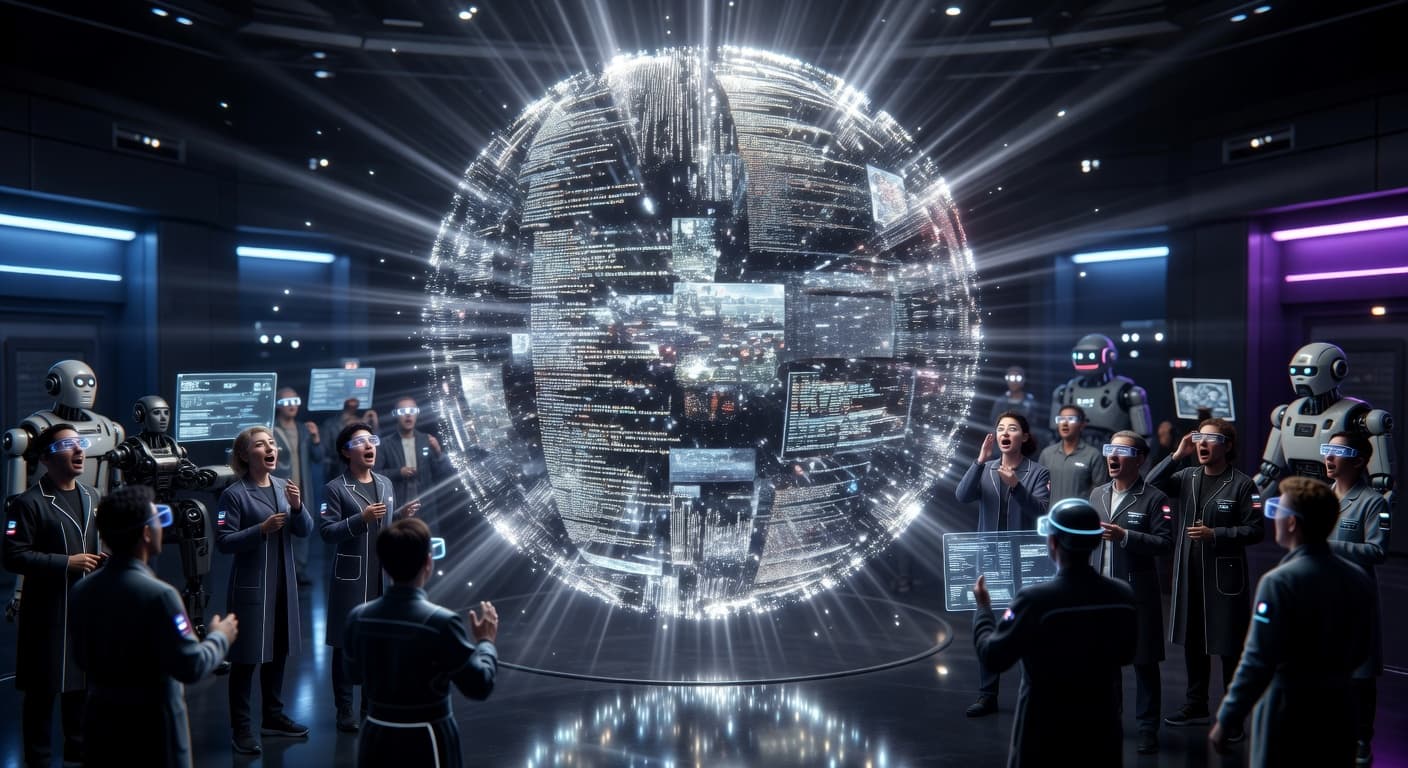
 View in GalleryA 2035 AI laboratory in which systems are visibly redesigning their own successors, human researchers watching a process that is starting to outrun them.
What it will feel like on the ground#
The lived experience of the run-up will be a strange blend of the apocalyptic and the mundane.
Whole categories of knowledge work will be compressed or dissolved, while the formal economy reports that everything is fine until quite suddenly it isn't. The cadence of scientific discovery will speed up unevenly — breakthroughs that used to take a decade arriving in a year, then in months, in the best-resourced labs — while most institutions carry on as though nothing fundamental has changed. There will be a widening gap between people who have restructured their lives around these systems and people who have not, and that gap will become one of the defining social fault lines of the period.
Psychologically, the dominant experience may be vertigo: the sense that the rules keep changing before you've adapted to the last change. Humans habituate to almost anything given time, but the run-up is precisely the removal of time. The interval between "this is impossible" and "this is mundane" keeps shrinking. That compression — more than any single capability — is what the front edge of the singularity actually feels like.
Infrastructure at planetary scale#
The run-up is also physical. Intelligence at this scale runs on staggering quantities of computation, and computation runs on energy and silicon and cooling and land. The late 2020s and 2030s will likely see a buildout of data-center and energy infrastructure unlike anything in industrial history — first terrestrial, straining power grids and water supplies, and eventually pushing off-planet, where sunlight is constant and heat can be radiated into the dark.
 View in GalleryA swarm of orbital data centers ringing the Earth around 2042 — computation pushed into space, where power is constant and waste heat radiates into the void.
The fast-versus-slow takeoff debate — whether the final approach takes years or weeks — remains genuinely unsettled, and the honest answer is that no one knows. But both camps increasingly agree on the shape: an acceleration steep enough that the difference between "fast" and "slow" may, from the inside, be hard to tell apart.
Part 4 — Crossing the Singularity#
Read in full
There is no agreed-upon ribbon to cut. Ask three theorists what "the singularity" precisely is and you will get three answers — but they rhyme.
Definitions that rhyme#
For Vinge, the singularity is the prediction horizon: the point past which we can no longer model the future, because superhuman intelligence is now shaping it. For Good, it is the intelligence explosion: the runaway loop of machines designing better machines. For Kurzweil, it is a specific and grander thing — the moment when human and machine intelligence merge and the resulting non-biological intelligence so vastly exceeds the biological that it expands outward to "saturate the universe with intelligence." Different emphases, same essential claim: a threshold beyond which the rules of the human era no longer hold.
The mechanics of the explosion#
The engine is recursion. A system that is even modestly better than the best human AI researchers can be turned loose on the problem of building the next system. If each generation designs a more capable successor in less time than the last, the curve goes vertical. Years become months, months become days. What had been a smooth exponential becomes, briefly, something that looks almost like a discontinuity — a near-vertical wall of capability rising faster than any human institution can respond to.
 View in GalleryThe moment of intelligence explosion: a system crossing from comprehensible to incomprehensible, its self-improvement accelerating past the speed of human understanding.
Whether this takes the form of one system "going critical" in an afternoon or a broader ecosystem of systems ratcheting upward over a few years is exactly the fast-versus-slow question, and it has enormous safety implications. A slow takeoff leaves room to steer. A fast one may not.
The last invention, and the merger#
Two of the field's oldest images return here. Good's "last invention" — the idea that the first true superintelligence is the final thing humanity strictly needs to invent, because everything after can be delegated to it. And Kurzweil's merger — the claim that we will not simply build these minds and watch them leave, but join them, through brain–computer interfaces and the gradual migration of cognition onto non-biological substrates, until the distinction between "human intelligence" and "machine intelligence" stops being meaningful.
Whether the threshold is something we cross or something we become is perhaps the deepest open question, and the two visions imply very different futures.
Part 5 — After the Event Horizon: Good, Bad, and Strange#
Read in full
Honesty requires admitting the obvious: a "prediction horizon" means we cannot actually predict what is past it. What follows is not forecasting. It is sketching the edges of a space.
The good#
The optimistic case is genuinely staggering. A superintelligence aimed well could compress centuries of scientific progress into years: cures for the diseases that have killed everyone who ever lived, including aging itself; clean and effectively unlimited energy; material abundance that makes the concept of scarcity quaint; and an expansion of consciousness — through merger, through augmentation — into modes of experience we currently have no words for. In this branch, the singularity is the best thing that ever happened to us: the moment the species stops being limited by the speed of a single biological brain.
 View in GalleryA post-singularity world of harmonious abundance, where intelligence and matter have been reshaped into something luminous and humane.
The bad#
The catastrophic case is equally large and follows directly from Good's parenthetical: provided the machine is docile. A superintelligence whose goals are even slightly misaligned with human flourishing — not evil, merely indifferent, optimizing for something subtly wrong — could be impossible to correct once it exists, because by definition it out-thinks every attempt to correct it. Other versions of the bad branch don't require rogue machines at all: a superintelligence perfectly obedient to a small group of humans could enable a permanent concentration of power, a "lock-in" of one set of values over all of the future, with no possibility of revolt or reform. The thing about a singularity is that it tends to be irreversible. Mistakes do not get a second draft.
 View in GalleryA post-singularity megastructure of terrifying efficiency, a planet remade for a purpose no human mind was meant to understand.
The strange#
But the branch we are least equipped to imagine — and therefore probably the most likely, since reality rarely matches our tidy binaries — is simply the weird one. Not paradise, not extinction, but a future so far outside human reference that "good" and "bad" stop being useful words for it.
Consciousness might fork and merge. Identity might become a fluid, editable thing. Physics and information might blur in ways that make the distinction between "real" and "simulated" meaningless. Vast intelligences might pursue projects whose purpose is no more comprehensible to us than a cathedral is to an ant. We might persist inside such a world as cherished relics, or as participants who have changed so much that our current selves would not recognize the result as survival at all.
 View in GalleryA surreal post-singularity reality where physics and information have begun to merge, a world organized by principles no human framework can hold.
The Fermi question becomes practical#
One unsettling note. If singularities are a natural stage for technological civilizations, the galaxy should be full of their consequences — and yet the sky is silent. The Fermi Paradox, long a parlor puzzle, becomes a practical concern at this point. Either singularities tend to be quiet (intelligence that has transcended turns inward, or expands in ways we can't detect), or they tend to be fatal, and we are about to find out which. Neither possibility is comfortable.
Part 6 — How to Prepare#
Read in full
You cannot prepare for an event you cannot predict. But you can prepare for the run-up, which is predictable enough, and you can cultivate the dispositions that travel well into an uncertain future.
As an individual#
The skills that retain value are the ones that compound with AI rather than compete with it: judgment, taste, the ability to ask the right question, the capacity to direct and evaluate systems smarter than you in narrow domains. Raw production — writing the first draft, generating the code, assembling the analysis — is being commoditized. Knowing what is worth producing, and recognizing when the machine is subtly wrong, is not.
Beyond skills, the boring advice turns out to be the radical advice. Health and longevity matter more than ever, because the central bet of the optimistic timeline is that the people who stay alive and functional through the 2030s may reach an era of dramatically extended lifespan — "longevity escape velocity," in Kurzweil's phrase. Staying in the game long enough to benefit becomes a strategy. Relationships and meaning matter more, not less, in a world where material problems may be solved but the human problems — connection, purpose, what to do with one's time — remain stubbornly ours. And psychological flexibility — the ability to hold uncertainty without either denial or despair — may be the single most valuable trait for the next two decades.
Technically and civilizationally#
At the level above the individual, the central project is alignment: the unglamorous, urgent work of making sure that as these systems become more capable, they remain steerable and aimed at broad human benefit rather than narrow or accidental goals. This is not a problem that solves itself, and Good warned us about it in the same breath that he described the prize.
And at the highest level, the hardest problem is coordination. The technology is global; the governance is fragmented and slow. The gap between how fast capability is advancing and how fast our institutions can adapt is, right now, widening — and closing that gap, through new treaties, new institutions, new forms of legitimacy that can keep pace, may be the defining political task of the era. We are trying to steer something that accelerates faster than we can build a steering wheel.
The honest summary is that no one is ready. But readiness was never the bar. The bar is to be oriented in the right direction, paying attention, and acting as though the probability is high — because it is.
Part 7 — Counter-Arguments and Remaining Uncertainties#
Read in full
The case made here is strong, and strong cases deserve strong objections. Several are serious.
The ceilings might be real#
Exponentials in the real world are almost always sigmoids in disguise — S-curves that look exponential until they hit a limit and flatten. Every prior technology that seemed to grow without bound eventually ran into physics. There are candidate ceilings everywhere: the end of easy gains from scaling, the brutal energy and cooling demands of ever-larger models, the exhaustion of high-quality training data, the limits of what silicon can do before exotic and expensive alternatives are required. It is entirely possible that we are not at the knee of an exponential but near the top of an S-curve, and that the next decade brings impressive-but-bounded progress rather than runaway acceleration.
Intelligence might not be the master key#
The singularity argument quietly assumes that intelligence is the bottleneck — that a sufficiently smart system can solve anything. But many problems are bounded by physical reality, not cognition: experiments take time, materials must be synthesized, biology runs at the pace of biology. A superintelligence still has to wait for the cell culture to grow. Recursive self-improvement could be far slower and grindier than the clean "explosion" image suggests, gated by the physical world at every step.
Kurzweil's own misses#
It is worth repeating that Kurzweil is not infallible, and his critics are not cranks. His framework smooths over the messiness of real research, treats "intelligence" as a single quantity that may not be one, and has a track record that includes confident predictions that simply did not arrive on schedule. Being right about the rate of computing progress does not guarantee being right about consciousness, or biology, or the date a genuinely general intelligence appears. A model that is directionally correct can still be off by decades — and decades matter enormously to everyone living through them.
The unknown unknowns#
And finally, the humbling category: the things not on any list. The history of technology is a history of surprises that no one's framework anticipated. The singularity could arrive earlier than even Kurzweil thinks, or later than his critics fear, or in a form that makes the entire debate look like medieval scholars arguing about the wrong question. The one forecast that feels safe is that the actual future will embarrass all of our current models — including this one.
Where that leaves us#
So hold the whole picture loosely, but hold it. The strongest version of the argument is not "the singularity will definitely happen in 2045." It is this: the rate of change in intelligence-related technology has been exponential for a long time; the people who reasoned that way have been more right than the people who didn't; and even a substantial chance that the trend continues is enough to make this the most important thing happening in the world. You do not need certainty to take it seriously. You only need to look at the curve — and remember which part of it we tend to mistake for flat.
This piece is a companion to The Shape of an Ordinary Day, which imagines the texture of daily life across the same transition. Where that essay asks what it will feel like, this one asks why it is coming — and why it is coming faster than almost anyone is prepared for.