What if the maps we trust are incomplete?
We live in an era of remarkable scientific confidence. Open any textbook or watch any documentary on cosmology, and you will hear a clear, consistent story: The universe began 13.8 billion years ago in a hot, dense state we call the Big Bang. It expanded, cooled, formed atoms, stars, galaxies, and eventually us. The cosmic microwave background radiation is the afterglow. Redshifted light from distant galaxies proves the expansion. Sophisticated models incorporating dark matter and dark energy explain the large-scale structure we observe.
The numbers feel precise. The narrative feels settled.
But what if this confidence is, at least in part, an illusion? What if the surprises that keep arriving from telescopes and probes are not minor anomalies to be patched with new parameters, but signals that our foundational picture is incomplete or even fundamentally misdirected? What if, despite all the equations and observations, we still have very little idea how the universe truly began, how old it really is, or how the solar system—and life within it—actually came to be?
This is not a call to reject science. It is an invitation to listen to voices that question the siren song of certainty—the seductive pull that makes us interpret every new piece of data through the lens of existing models, even when those models require ever more exotic patches.
The Siren Song of Certainty#
Read in full
Wilson observed that astronomers and cosmologists frequently announce "surprising" discoveries—from unexpected planetary features to massive galactic structures that challenge timelines. Often, the researchers themselves note that the findings suggest we may need to rethink fundamentals. Yet the community rarely treats these as existential threats to the paradigm. Instead, the models absorb the surprises through adjustments, new dark components, or revised parameters. The unexpected becomes unsurprising because the framework must be preserved.
The siren song lulls us into believing we are close to the truth, when in reality we may be circling a local minimum of understanding.
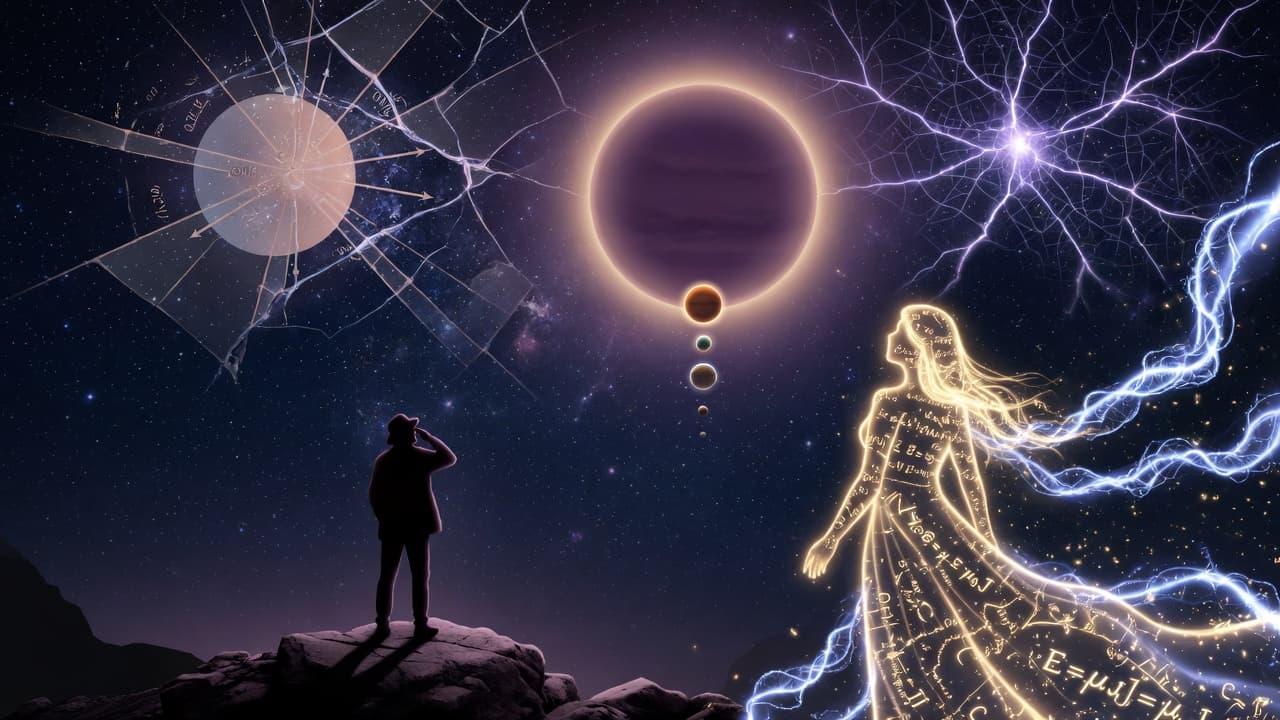
 View in GalleryThe Siren Song of Certainty
A cosmologist on a fractured ridge, lured by an ethereal siren woven from equations and the ΛCDM model, while plasma lightning and alternative cosmic visions — Proto-Saturn, ancient observers — appear through the cracks in the paradigm. The seductive pull of certainty versus the wilder possibilities beyond.
How the absorption works#
Nowhere is this more evident than in cosmology. The horizon and flatness problems were met with cosmic inflation—an exponential early expansion whose details remain speculative. The lithium abundance mismatch has lingered for decades without a clean resolution. When JWST revealed galaxies that appear too mature, too numerous, and too structured for the available time, the response was typically to revise star-formation efficiency or dust assumptions rather than revisit the underlying distance or expansion framework. The Hubble tension between early- and late-universe measurements of the expansion rate is addressed with proposals for evolving dark energy or new particles.
Each patch preserves the core narrative. The model is treated as fundamentally sound; only the parameters need tuning.
Cracks in the Standard Story#
Read in full
Most strikingly, the model requires that ~95% of the universe's energy density be in the form of dark matter and dark energy—entities we have never directly detected and whose properties are defined largely by what is needed to make the equations fit observations. When a theory needs invisible scaffolding for most of its structure, it is reasonable to ask whether the scaffolding or the foundation itself needs examination.
Persistent anomalies the model must continually patch#
The horizon and flatness problems were solved by invoking cosmic inflation—an exponential expansion phase in the first 10⁻³² seconds whose details remain speculative and whose predictions have mixed success in matching later data. The lithium problem (Big Bang nucleosynthesis predicts roughly three times more primordial lithium than the oldest stars actually contain) has resisted resolution for decades.
Halton Arp documented cases of high-redshift quasars appearing physically connected by bridges to low-redshift galaxies, suggesting that at least some redshift may be intrinsic rather than purely a distance indicator. Hannes Alfvén, whose plasma physics won a Nobel, rejected the Big Bang as an unfalsifiable extrapolation beyond laboratory-tested physics and developed an alternative ambiplasma cosmology with Oskar Klein.
In 2004, an Open Letter to the Scientific Community signed by Lerner, Arp, and others (including steady-state proponents) charged that the model survives only by adding hypothetical entities—inflation, dark matter, dark energy—each invented to rescue it from contradiction.
 View in GalleryCracks in the Model vs. Plasma First Principles
The standard model sustained by layers of invisible dark scaffolding and ad-hoc patches, contrasted with plasma and electromagnetic processes that naturally scale from laboratory experiments to cosmic structure. A central choice of frameworks.
Enter alternative perspectives that attempt to explain the same observations with different assumptions—often simpler ones rooted in plasma physics, electromagnetism, and laboratory-reproducible phenomena rather than purely mathematical exotica.
The Electric Universe: Plasma, Electricity, and a Different Gravity#
Read in full
In the Electric Universe view:
- Stars are not isolated nuclear furnaces but electrically driven phenomena, powered by currents flowing through galactic plasma. Their spectra, variability, and even "failed stars" like brown dwarfs make more sense as electrical discharge states than as purely gravitational objects.
- Many cosmic structures—filaments, jets, double radio lobes, and the cosmic web itself—match plasma behaviors observed in laboratories far better than gravitational collapse models.
- Gravity itself may not be a fundamental force but a subtle, long-range manifestation of electric dipoles within matter (Thornhill's "electric gravity" model). This offers a potential explanation for the equivalence of inertial and gravitational mass without invoking separate mechanisms. Mass itself becomes an electrical variable in this framework; changing a body's charge environment can alter its effective gravitational behavior, making otherwise difficult orbital captures and rapid reconfigurations dynamically plausible.
 View in GalleryCosmic Plasma Filaments and Birkeland Currents
The universe as an interconnected web of electric currents: plasma filaments organizing stars and galaxies, a core visual of the Electric Universe and plasma cosmology frameworks.
One of the most radical implications comes from Thornhill's work on solar system history, drawing from David Talbott's mythological research and Dwardu Cardona's studies, with physical modeling by Thornhill himself — explored further in the next section.
Proto-Saturn and a Recent Cosmic Upheaval#
Read in full
In this environment, Earth would have experienced uniform, shadowless illumination from the anode glow of the brown dwarf's plasma envelope: a gentle, mauve-tinted "eternal day" consistent with descriptions of a primordial Golden Age in global mythologies. There were no seasons as we know them. Saturn appeared fixed and immense in the northern sky.
 View in GalleryThe Purple Dawn — Earth's Primordial Sky
Earth bathed in the shadowless mauve glow of its former brown-dwarf host star, fixed at the celestial pole — the primordial environment proposed in Electric Universe reconstructions of solar system history.
The Primordial Environment#
Proto-Saturn was not a conventional fusion star but a dim brown dwarf — the most common stellar type. In the electric model its radiance came from a vast anode-glow plasma sheath rather than a core furnace: a gentler, more stable cradle for planets and prebiotic chemistry. Dwardu Cardona (in his God Star series) termed this the "purple dawn of creation"; David Talbott reconstructed the polar configuration from convergent global myths in The Saturn Myth and his Symbols of an Alien Sky films; Wallace Thornhill supplied the plasma physics and capture mechanics.
The Capture and Upheaval#
When this system encountered the Sun's electrical domain, a catastrophic interaction occurred — flaring, mass ejection (Venus perhaps Saturn's "last born," launched as a comet-like body), and a dramatic rearrangement of planets into a temporary axial "stacked" configuration before settling into today's orbits. Many planetary scars (Valles Marineris on Mars as a vast electrical trench, the Moon's craters and rilles, Earth's geology) and the rings of Saturn itself may be relatively recent electrical discharge features rather than ancient impact records. Cassini-era studies concluded the rings are young and ephemeral (tens of millions of years at most); a 2018 Icarus study reported water across Saturn's rings and moons isotopically like Earth's — unexpected in standard formation models but a natural signature if the systems shared a recent common history.
Why It Matters for How We Got Here#
If even partially correct, this reframes "how we got here." The stable solar system we take for granted may be a recent development on human timescales, not deep time. Ancient myths worldwide — stories of a polar sun, a golden age without night or winter, world-ending dragon storms and deluges — might preserve actual eyewitness or cultural memory of these events rather than pure fantasy or allegory.
See the companion article on this site, Electrically Driven Stars and Galaxies, for a deeper look at Thornhill's Birkeland currents, the electric Sun model, and how plasma filaments may structure galaxies.
Whether or not the details hold, the Electric Universe approach reminds us that electromagnetism scales across vast distances in ways gravity-only models struggle to match without dark matter crutches. Laboratory plasma experiments reproduce many cosmic morphologies that require elaborate simulations in the standard picture.
Eric Lerner and Plasma Cosmology: No Bang Required#
Read in full
Lerner argues that the Big Bang model has repeatedly failed key observational tests and that its mathematical elegance has been prioritized over empirical correspondence. Instead, he advocates a universe without a singular hot beginning.
Plasma as the Architect#
- Large-scale structure forms through plasma instabilities, filamentation, and electromagnetic forces—processes that can be studied in laboratories and do not require a primordial explosion.
- Redshift may have contributions beyond (or instead of) pure Doppler expansion from an expanding universe. Plasma effects or other energy-loss mechanisms could play roles.
- The universe may be vastly older than 13.8 billion years—or even infinite in extent and duration in a broad sense—evolving through continuous processes rather than a one-time creation event followed by cooling.
The Surface-Brightness Test#
His sharpest quantitative argument is the surface-brightness (Tolman) test. In an expanding universe, galaxy surface brightness should fade steeply with redshift as (1+z)^−4; in a static universe it remains roughly constant. Lerner and collaborators reported surface brightness staying essentially constant out to high redshift (z ≈ 5), consistent with a non-expanding, Euclidean cosmos. JWST's early images of galaxies that appear "too many, too smooth, too small, and too old" for a 13.8-billion-year timeline fit this picture in his reading.
Lerner also proposes that the cosmic microwave background is thermalized starlight re-radiated by a filamentary intergalactic medium, and that light elements are forged by ongoing stellar and plasma processes rather than a brief Big-Bang nucleosynthesis. His critique highlights how the standard model often retrofits observations (early galaxy formation, for example) with increasingly complex additions like inflation or modified dark energy equations, while plasma approaches start from known physics of ionized matter and scale upward.
 View in GalleryEric Lerner and Plasma Cosmology: No Bang Required
A laboratory dense-plasma-focus device firing plasma arcs that transform into an infinite web of cosmic filaments and galaxies with no central Big Bang origin; a scientist studies surface-brightness data that remains flat, beside an open copy of 'The Big Bang Never Happened'. Laboratory plasma physics scales directly to the structure of the cosmos.
From Cosmos to the Lab#
Notably, Lerner puts the same plasma toolkit to experimental use: through LPPFusion he has pursued dense plasma focus devices aiming at hydrogen-boron fusion — clean, direct-conversion energy. The laboratory program serves as a practical demonstration that the plasma phenomena invoked for cosmic structure are real, reproducible, and potentially useful here on Earth.
Paul LaViolette and Subquantum Kinetics: Tired Light and Continuous Processes#
Read in full
LaViolette models subatomic particles not as point-like billiard balls or abstract quantum fields in a vacuum, but as self-organizing dissipative wave patterns or solitons within a subquantum "ether" or reaction-diffusion medium — his "Model G." This open-system approach unifies electromagnetic, gravitational, and nuclear forces under a single kinetic framework and predicts that matter and energy emerge continuously throughout space (what he called genic energy).
Tired Light and a Static Universe#
Cosmologically, LaViolette proposes a non-expanding universe in which the observed redshift of distant galaxies results primarily from "tired light"—photons gradually losing energy through interactions with the subquantum medium over vast distances—rather than from universal expansion. There was no Big Bang singularity or primordial fireball; the universe has no specific "age" in the conventional sense; it is an ongoing, open process. Many problems that plague the expanding model (horizon, flatness, lithium, early structure) simply do not arise. He argued his tired-light predictions fit certain observational datasets more cleanly than expansion models without requiring dark energy or other ad hoc components.
 View in GalleryTired Light — Photons Losing Energy Across the Subquantum Medium
In LaViolette’s subquantum kinetics, photons gradually lose energy as they travel vast distances through the active ether, producing redshift without requiring universal expansion. The core alternative to Doppler recession.
Galactic Superwaves and Recent History#
His galactic superwave hypothesis adds a dramatic recent chapter: periodic explosive outbursts from the galactic core send volleys of cosmic rays that can trigger climate shifts on Earth, including the end of the last ice age and the Younger Dryas. Evidence he assembled includes beryllium-10 spikes, cosmic dust, and iridium in ice cores. In Genesis of the Cosmos and Earth Under Fire he further proposed that the physics of continuous creation and these galactic events was known to the ancients and encoded in myth, the Tarot major arcana, and zodiacal symbolism.
 View in GalleryGalactic Superwave — Recent Cosmic Events and Human Memory
LaViolette’s model of periodic galactic core explosions sending cosmic rays that can trigger ice-age terminations and cultural memories. Evidence includes beryllium-10 spikes and dust in polar ice; myths may preserve the record.
While highly speculative and outside mainstream acceptance, subquantum kinetics represents exactly the kind of "simpler underlying mechanism" that might be missing—replacing layers of exotic math with a reaction-kinetic model inspired by systems theory and nonequilibrium thermodynamics. LaViolette's work, like the others here, invites us to ask whether we still have no real clue how we (and the solar system) truly got here — or what recent galactic-scale events may have shaped our story.
Why These Perspectives Matter (Even If Imperfect)#
Read in full
Yet their value lies precisely in what they force us to reconsider:
- The assumption that gravity is the only long-range force shaping the cosmos.
- The necessity of a singular beginning in a hot, dense state.
- The idea that redshift equals pure recession velocity.
- The reliance on invisible dark components whose only evidence is gravitational.
- The tendency to invent new physics at cosmic scales rather than scaling up well-understood laboratory plasma and electromagnetic phenomena.
 View in GalleryWhy These Perspectives Matter (Even If Imperfect)
A scientist stands between two worlds at a cracked blackboard: on one side the patched and scaffolded ΛCDM model with dark matter, dark energy and inflation; on the other, clean plasma globes, Birkeland currents, mythic symbols and laboratory instruments connected by living light. The figure holds a glowing first-principles compass, books by the alternative thinkers at their feet. The enduring value of questioning and testing simpler alternatives.
History shows that abandoned or marginalized ideas sometimes contain seeds of later revolutions. Hannes Alfvén's plasma work was once sidelined; steady-state cosmologies were largely discarded after the CMB discovery. Yet questions they raised about structure formation and the interpretation of redshift persist in new forms. The 2004 Open Letter and the ongoing surface-brightness and early-galaxy data keep those questions alive.
Perhaps the path forward involves not ever-more-complex mathematics layered atop the Big Bang, but a return to first principles: What do we actually observe? What reproduces in the lab? What assumptions are we making about the nature of light, gravity, and the medium of space itself? The alternatives explored here do not have to be complete to be useful—they only have to be taken seriously enough to test.
An Invitation to Wonder#
Read in full
We do not know with the certainty the textbooks project.
Tom Wilson, Wallace Thornhill, Eric Lerner, Paul LaViolette, and others like them do not have all the answers either. But they remind us that the map is not the territory, and that the siren song of certainty can deafen us to other melodies—melodies that might ultimately lead to a richer, stranger, and perhaps simpler understanding of how we and the cosmos came to be.
The next time you hear a confident pronouncement about the universe's origin and age, pause. Ask what assumptions underpin it. Consider what a plasma filament, an electric dipole, or a tired photon might have to say instead.
The universe is under no obligation to conform to our current models. And we are under no obligation to stop questioning them.
 View in GalleryAn Invitation to Wonder
A solitary contemplative figure sits on an ancient stone outcrop at the edge of a calm dark sea under a vast night sky that fluidly blends multiple cosmic possibilities — a soft fading glow of a possible primordial fireball on the far left horizon, flowing interconnected plasma webs and filaments arching across the zenith, a brown dwarf star with a string of aligned smaller orbs fixed in the northern sky, and distant galaxies whose light trails fade gently as if losing energy. An open journal and pen rest on the rock beside the figure, its visible pages filled with sketches of question marks intertwined with both standard model diagrams and plasma/electric alternatives, plus the handwritten phrase 'we do not know'. The mood is humble wonder, open curiosity, and an invitation to keep questioning rather than a firm conclusion.
Further Exploration
- Tom Wilson – "When the Surprise Is Unsurprising: The Siren Song of Certainty" (EU2015 presentation)
- Wallace Thornhill & the Thunderbolts Project – holoscience.com, YouTube Space News, and the curated Electric Universe section at science.openmindspace.org/electric-universe (especially Proto-Saturn, Electric Gravity, Plasma Universe, and Big Bang dissent pages)
- Companion on this site: Electrically Driven Stars and Galaxies: Wallace Thornhill's Birkeland Currents in the Electric Universe
- Eric Lerner – The Big Bang Never Happened; LPPFusion lab work; surface-brightness papers (2014, 2018) and his 2022 IAI essay on JWST
- Paul LaViolette – Subquantum Kinetics, Genesis of the Cosmos, Earth Under Fire; Starburst Foundation (starburstfound.org) and etheric.com for publications and videos
- David Talbott – The Saturn Myth and the Symbols of an Alien Sky / Discourses on an Alien Sky video series
This article is a thought experiment and synthesis meant to stimulate open inquiry. It does not claim these alternative models are proven or complete. Science advances through rigorous testing of all serious ideas. The illustrations were created to evoke the themes visually.