
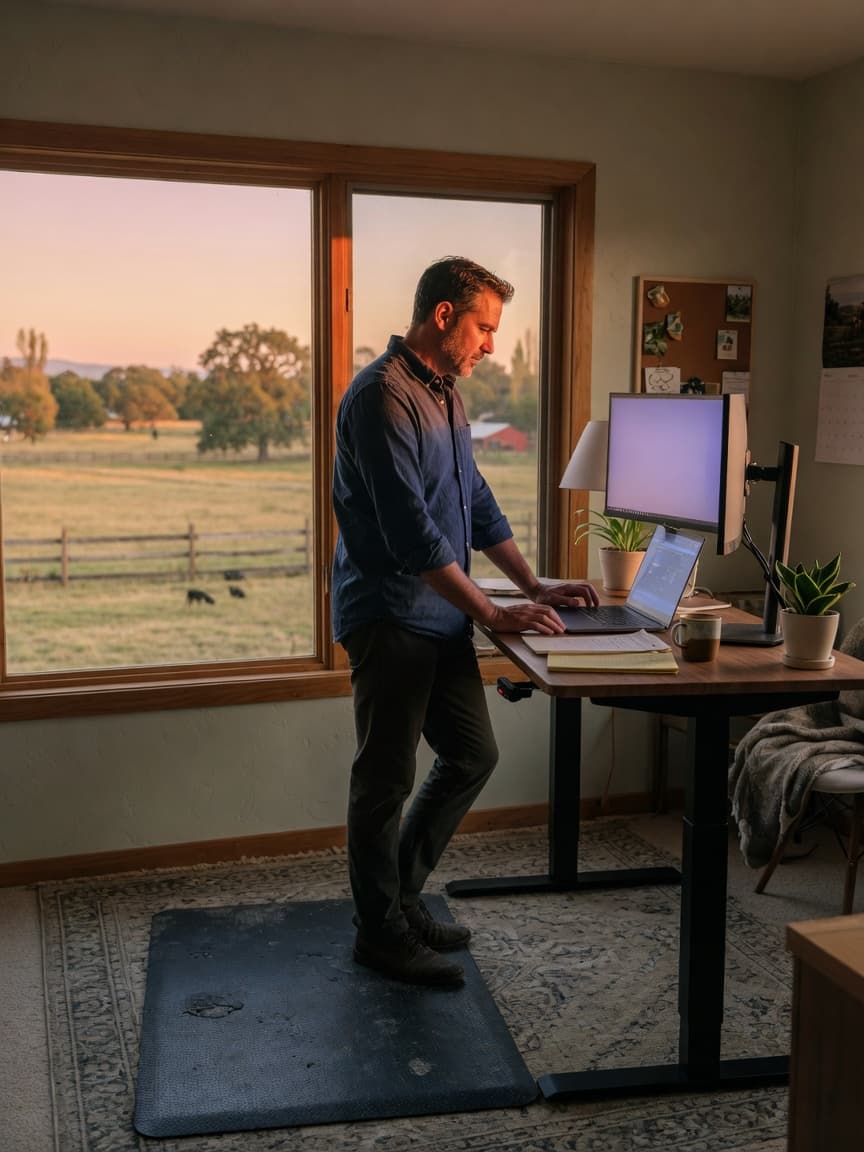
If you do your best thinking at a desk — coding, writing, designing, managing agents, running a homestead spreadsheet, or simply trying to stay sharp through another long day of knowledge work — you probably own what might be the most dangerous piece of furniture in your home. It is not dramatic to say so. The research on prolonged sitting is that sobering.
This article is inspired by SpoonFedStudy's video You can lose 20 lbs doing basically NOTHING, which walks through hundreds of papers on inactive physiology, non-exercise activity thermogenesis (NEAT), and the surprisingly large metabolic payoff of standing and moving while you work. The video's hook is weight loss. The deeper story is broader: how modern desk life quietly degrades metabolism, cognition, vascular health, and long-term mortality — and how small, frictionless movement habits may reverse more of that damage than an hour at the gym.
We spend a lot of intellectual life on rockets, AI, and the shape of the future. But the future is also lived in a body. For many of us, that body now spends ten or more hours a day in a chair. Wellness is not separate from technology — the same people building the next century are often doing it from a seated position that evolution never designed.
The central claim is simple: sitting is not neutral rest. It is an active biological state with its own harmful chemistry. Standing and moving while working — especially in frequent short bursts — can improve metabolic health, cognitive performance, and energy expenditure with far less willpower than most gym-centric programs demand. The chair is not the enemy of productivity. Prolonged stillness is.
To make the cost visible, two hypothetical timelines later in this piece walk through what sustained sitting tends to do across one workday and one working life — hour by hour, then decade by decade. They are not prophecies. They are maps of what the hours are quietly doing.
The Core Claim at a Glance#
Read in full
| Topic | What the research indicates |
|---|---|
| Mortality | Meta-analyses link more daily sitting time to higher all-cause mortality. Risk rises with each additional hour; inflection points appear around 7–10 hours per day. |
| Exercise alone | Meeting exercise guidelines does not fully cancel sitting's harms. The "active couch potato" — fit in the gym, sedentary all day — remains at elevated metabolic risk. |
| Inactive physiology | Sitting suppresses leg-muscle electrical activity, fat-burning enzymes, and calf-driven circulation; inflammatory markers rise. |
| NEAT | Non-exercise activity thermogenesis — walking, standing, fidgeting, chores — often dominates structured exercise in total daily calorie burn. |
| 30-and-5 breaks | ~5 minutes of walking per ~30 minutes of sitting improves glucose, blood pressure, and enzyme activity in intervention research. |
| Standing + fidgeting | Standing desks, weight-shifting, and uneven anti-fatigue mats can add hundreds of calories of daily expenditure without a gym session. |
| Weight-loss context | Aggressive dieting triggers metabolic adaptation; diet breaks (Matador study) and protein-forward breakfasts may improve long-term outcomes. |
None of this replaces medical care, individualized nutrition advice, or structured exercise for cardiovascular fitness. It reframes the baseline: what you do between workouts may matter as much as the workouts themselves.
The Active Couch Potato#
Read in full
The uncomfortable update from sedentary-behavior research is that how long you sit is an independent variable. You can be a person who meets or exceeds official exercise guidelines and still spend the remaining fourteen waking hours in near-total stillness. Scientists have a label for this: the active couch potato.
The pattern shows up in waist circumference, blood pressure, triglycerides, and insulin sensitivity. An intense morning workout helps. It does not erase eight consecutive hours in a chair. A Lancet meta-analysis of more than a million people found that only those in the top quartile of daily activity — on the order of 60–75 minutes of fairly intense exercise every day — appeared to mitigate some of the excess risk associated with very high sitting time. Even then, risk was reduced, not eliminated.
That is a staggering bar. Most people will never live there. And it suggests a strategic mistake many health-conscious desk workers make: they optimize the hour at the gym while ignoring the other nine hours that define their metabolic environment.
If you have ever finished a hard workout, felt virtuous, and then collapsed into a chair for the rest of the day, you have lived this paradox. The biology does not care about your moral accounting. It cares about muscle electrical activity, circulation, enzyme production, and how often you stir the pool.
How the Chair Became the Default#
Read in full
The chair is a triumph of civilization. It is also a trap.
Consider how recently the knowledge-worker day assumed its present shape. For most of the twentieth century, factory labor was the iconic health worry — repetitive motion, chemical exposure, physical injury on the line. The office was treated as safer. In the twenty-first century, cognitive labor scaled: software, finance, design, administration, content, remote coordination, agent supervision. The body did not receive a firmware update. It still expects walking, squatting, lifting, turning, and frequent postural change.
Television accelerated evening sitting. Computers universalized daytime sitting. Smartphones added a third posture — curled, neck-forward, motionless — without removing the first two. Epidemiologists began noticing that mortality curves bent wrong for people who were "healthy" on paper. They exercised. They did not smoke. They still sat ten hours and wondered why metabolic syndrome found them anyway.
Meta-analyses link more daily sitting time to higher all-cause mortality, with steeper slopes after roughly seven hours and substantially elevated risk bands around ten hours per day. Individual studies vary in effect size and covariate adjustment. The directional consensus in sedentary-behavior science is stable: time in chair is not a neutral input.
Sitting is also implicated as an independent risk factor for dementia and Alzheimer's disease in large prospective cohorts — not merely because sedentary people exercise less, but because inactive physiology may directly impair cerebral blood flow and metabolic clearance in the brain. Your focus stack, IDE, and agent orchestration layer all run on the same vascular infrastructure that prolonged stillness quietly degrades.
Inactive Physiology: What Sitting Actually Does#
Read in full
Why is sitting so harmful if it feels like rest?
A useful image from the sedentary-behavior literature: think of your brain and muscles as a fluid reservoir. Blood, glucose, signaling molecules, and metabolic waste products are meant to circulate. When you sit motionless for long stretches, those fluids pool. Gravity pulls blood into the legs. The calves — which function almost like a secondary heart, pumping blood back upward — go electrically quiet. The result is a kind of metabolic sludge: sluggishness, brain fog, lower energy, and over long horizons, higher inflammatory tone.
Researchers now treat this as its own field: inactive physiology. The claim is that sitting is not the absence of activity. It is a distinct physiological mode with distinct consequences.
Within minutes of taking a seat, several cascades begin:
- Electrical silence in leg muscles, especially the calves, collapsing the peripheral pump that supports venous return.
- Suppression of lipoprotein lipase (LPL) and other enzymes central to fat metabolism in large postural muscles — back, glutes, thighs, abs. Fat stays in the bloodstream longer; HDL-related processes suffer.
- A sharp drop in fat-oxidation enzyme activity — some studies suggest production of crucial enzymes can fall on the order of 90% during prolonged sitting.
- Reduced cerebral blood flow and vascular effects that show up in cognition and mood, not only in cardiometabolic labs.
- Rise in inflammatory markers such as IL-6 and C-reactive protein, linking sedentary time to the slow fire of chronic low-grade inflammation.
Sit long enough — in a car, a plane, a binge-watch session — and stagnation can become clots. The body is not failing mysteriously. It is responding exactly as it would to a position it never evolved to hold for eight hours at a stretch.
For most of human history, survival required movement: walking, carrying, digging, climbing, fleeing. Chairs are recent. Your nervous system still reads stillness as a signal to downshift every expensive system it can.
The Sitting Timeline: One Day, One Life#
Read in full
Abstract mortality statistics are easy to shrug off. They describe millions of people, not you at 2:47 p.m. on a Tuesday. A more useful exercise is to walk through what sustained sitting tends to do — first across one long day, then across a life — as a composite sketch drawn from inactive-physiology and sedentary-behavior research. This is not a diagnosis or a prediction for any one person. It is a way to see the bill as it accrues.
One workday: eight hours in the chair#
Imagine a knowledge worker — developer, writer, administrator, homestead bookkeeper — who sits through a typical day with no standing desk, no walking breaks, and a gym session saved for after work.
| Time | What is likely happening |
|---|---|
| 7:30 AM | Coffee, commute, desk. You feel fine. Postural muscles are still carrying their share of the load. |
| 8:00 AM | Deep-work block begins. Within minutes, calf muscles go electrically quiet. The peripheral pump that returns blood toward the heart starts to idle. |
| 9:30 AM | ~90 minutes in. Lipoprotein lipase and fat-oxidation enzyme activity in large leg and trunk muscles have fallen sharply — some studies report declines on the order of 90% during prolonged sitting. Blood pools in the lower body. |
| 11:00 AM | Three hours without a real break. Cerebral blood flow is lower than it would be during light movement. The focus you are counting on this afternoon is already being taxed. |
| 12:30 PM | Lunch at the desk; back in the chair within fifteen minutes. Inactive physiology never fully resets. Post-meal glucose and triglycerides clear more slowly than they would if you had walked even twice this morning. |
| 2:00 PM | The slump. Neck stiffness, low-back ache, brain fog. Easy to blame on lunch or willpower. Harder to see it as predictable circulation and enzyme suppression. |
| 4:00 PM | Six cumulative seated hours. Inflammatory markers such as IL-6 are elevated relative to a day broken up by movement. If the commute home is another hour in a car, the calves stay offline. |
| 6:30 PM | Gym or a walk. Genuinely helpful — and genuinely incomplete. An hour of exercise does not rewind eight hours of inactive physiology. The active couch potato pattern is in play unless movement was woven through the day. |
| 9:00 PM | Evening screen time adds another one to two hours. Total daily sitting crosses ten. Meta-analytic mortality curves inflect steeply in this band — not because any single evening session is lethal, but because the day's total load is. |
7:30 AM#
What is likely happening#
Coffee, commute, desk. You feel fine. Postural muscles are still carrying their share of the load.
8:00 AM#
What is likely happening#
Deep-work block begins. Within minutes, calf muscles go electrically quiet. The peripheral pump that returns blood toward the heart starts to idle.
9:30 AM#
What is likely happening#
~90 minutes in. Lipoprotein lipase and fat-oxidation enzyme activity in large leg and trunk muscles have fallen sharply — some studies report declines on the order of 90% during prolonged sitting. Blood pools in the lower body.
11:00 AM#
What is likely happening#
Three hours without a real break. Cerebral blood flow is lower than it would be during light movement. The focus you are counting on this afternoon is already being taxed.
12:30 PM#
What is likely happening#
Lunch at the desk; back in the chair within fifteen minutes. Inactive physiology never fully resets. Post-meal glucose and triglycerides clear more slowly than they would if you had walked even twice this morning.
2:00 PM#
What is likely happening#
The slump. Neck stiffness, low-back ache, brain fog. Easy to blame on lunch or willpower. Harder to see it as predictable circulation and enzyme suppression.
4:00 PM#
What is likely happening#
Six cumulative seated hours. Inflammatory markers such as IL-6 are elevated relative to a day broken up by movement. If the commute home is another hour in a car, the calves stay offline.
6:30 PM#
What is likely happening#
Gym or a walk. Genuinely helpful — and genuinely incomplete. An hour of exercise does not rewind eight hours of inactive physiology. The active couch potato pattern is in play unless movement was woven through the day.
9:00 PM#
What is likely happening#
Evening screen time adds another one to two hours. Total daily sitting crosses ten. Meta-analytic mortality curves inflect steeply in this band — not because any single evening session is lethal, but because the day's total load is.
The short-term takeaway is blunt: by mid-afternoon, you are not failing at focus — you are sitting through the physiological conditions that make focus harder. Stiffness, fog, and the 3 p.m. crash are not character flaws. They are what the literature predicts when leg muscles stay electrically silent for hours.
One lifetime: the compounding chair#
Now zoom out. Same default posture, year after year — desk job, driving, streaming, scrolling. Exercise on the side, but sitting as the texture of life.
| Stage | What the research suggests tends to accumulate |
|---|---|
| 20s | First real desk career. The body compensates. Weight is stable. Nothing feels urgent. Inactive physiology is already running, but the invoice is deferred. |
| 30s | A decade of default sitting. Waist circumference creeps despite gym membership. Fasting glucose drifts toward the high end of normal. Stress and "getting older" get the blame. |
| 40s | Insulin sensitivity is worse than your exercise log implies. Blood pressure nudges up. Low-grade inflammation becomes a background hum — cohort studies link years of sedentary time to IL-6 and C-reactive protein, not only to body weight. |
| 50s | Metabolic-syndrome risk rises independently of whether you meet exercise guidelines. Large prospective studies associate high daily sitting time with dementia and Alzheimer's risk — not merely because sedentary people exercise less, but because decades of reduced cerebral blood flow and clearance may matter on their own. |
| 60s | Hip flexors shorten, glutes under-recruit, balance subtly erodes from years of collapsed posture. Cardiovascular risk has been accumulating hour by hour for decades. A fall that would have been nothing at thirty can be a fracture at sixty. |
| 70s+ | All-cause mortality curves from sedentary-behavior meta-analyses stop being abstractions. They are the statistical shadow of tens of thousands of seated hours — each hour contributing a small, non-zero increment of risk that no single gym session erases retroactively. |
20s#
What the research suggests tends to accumulate#
First real desk career. The body compensates. Weight is stable. Nothing feels urgent. Inactive physiology is already running, but the invoice is deferred.
30s#
What the research suggests tends to accumulate#
A decade of default sitting. Waist circumference creeps despite gym membership. Fasting glucose drifts toward the high end of normal. Stress and "getting older" get the blame.
40s#
What the research suggests tends to accumulate#
Insulin sensitivity is worse than your exercise log implies. Blood pressure nudges up. Low-grade inflammation becomes a background hum — cohort studies link years of sedentary time to IL-6 and C-reactive protein, not only to body weight.
50s#
What the research suggests tends to accumulate#
Metabolic-syndrome risk rises independently of whether you meet exercise guidelines. Large prospective studies associate high daily sitting time with dementia and Alzheimer's risk — not merely because sedentary people exercise less, but because decades of reduced cerebral blood flow and clearance may matter on their own.
60s#
What the research suggests tends to accumulate#
Hip flexors shorten, glutes under-recruit, balance subtly erodes from years of collapsed posture. Cardiovascular risk has been accumulating hour by hour for decades. A fall that would have been nothing at thirty can be a fracture at sixty.
70s+#
What the research suggests tends to accumulate#
All-cause mortality curves from sedentary-behavior meta-analyses stop being abstractions. They are the statistical shadow of tens of thousands of seated hours — each hour contributing a small, non-zero increment of risk that no single gym session erases retroactively.
The long-term takeaway is equally blunt: the chair bills slowly enough that you do not notice until the balance is large. That is why sedentary behavior slipped past public-health messaging for so long. The harm is not dramatic like a heart attack after a sprint. It is cumulative — the way interest compounds, except you are paying it.
What changes the story#
Neither timeline is destiny. They are the default plotline for uninterrupted sitting.
Interrupt the day timeline and the afternoon rewrite begins immediately: five minutes of walking every thirty minutes restarts leg-muscle electrical activity, restores fat-burning enzyme production, and improves post-meal glucose handling in intervention research. Stand and fidget through the morning and the 2 p.m. slump often softens before it arrives. The lifetime timeline stretches when sitting stops being the background and movement becomes the default texture of work.
The sections that follow — NEAT, the 30-and-5 protocol, standing workstations — are not wellness accessories. They are plot twists in these two stories. The timelines are here so you can see what you are interrupting.
Metabolic Adaptation and the Limits of Willpower#
Read in full
The Biggest Loser is useful here not for spectacle but for mechanism. Contestants lose staggering weight under extreme intervention — and many regain it as resting metabolism remains suppressed years later. Danny Cahill's story — on the order of 800 calories per day below expected resting burn six years after the show — is an outlier portrait of a common pattern: metabolic adaptation.
When the body detects sustained fat loss, it interprets emergency. Ghrelin rises. Leptin signaling weakens. The brain escalates hunger and dampens expenditure. Fast-twitch muscle — metabolically expensive — is among the first tissues the body stops favoring. Subconscious NEAT drops after exhausting workouts: you move less for the rest of the day without noticing.
This matters for desk workers who try to solve weight problems with gym heroics alone. You can win the hour and lose the day. Aggressive deficits plus prolonged sitting plus suppressed NEAT is a three-front war against your own endocrine system.
The asymptote of impossibility is the name some researchers give the invisible floor where each additional pound requires disproportionate suffering because biology is hoarding energy for a famine that never arrives. The strategic response is not more shame. It is better systems — and several principles from the weight-loss literature belong in a desk-movement article because they protect the metabolism you are trying to upgrade.
Preserve type II muscle. Fast-twitch fibers are metabolically expensive. Aggressive deficits and inactivity push the body toward cheaper slow-twitch profiles and lower resting burn. Brief explosive work during desk breaks — burpees, jump squats, kettlebell swings if available — signals that strength remains worth maintaining.
Protein leverage and breakfast. The protein leverage hypothesis proposes that appetite stays engaged until a protein threshold is met. A high-carb, low-protein morning can leave you snacking by mid-morning; a protein-forward breakfast blunts later glucose spikes through slower gastric emptying — the "second meal effect." Movement increases expenditure; protein helps you not out-eat the gain.
Matador diet breaks. In the Matador study, obese men dieting two weeks on and two weeks at maintenance over thirty weeks lost substantially more weight than men dieting continuously for sixteen weeks. Breaks may blunt leptin suppression and the starvation panic that makes every subsequent pound harder. Desk NEAT and diet strategy are complementary: you are building a system, not executing a single heroic tactic.
NEAT: The Engine Hidden in Ordinary Movement#
Read in full
If sitting is a metabolic downshift, where does the upside live?
Not primarily in the gym — or not only there. Enter NEAT: non-exercise activity thermogenesis. NEAT is all the movement you perform outside structured exercise: pacing while on a phone call, cooking, gardening, climbing stairs, shifting your weight at a standing desk, squeezing a tennis ball under your foot during a meeting.
Total daily energy expenditure is usually discussed in four buckets:
- BMR — basal metabolic rate, the calories required to keep you alive at rest.
- TEF — thermic effect of food, energy spent digesting and storing meals.
- EAT — exercise activity thermogenesis, your gym session or run.
- NEAT — everything else physical.
Most people intuit that EAT dominates. It often does not. For many desk-bound adults, NEAT is the largest modifiable slice of the day. Two people with similar bodies and similar workouts can differ by hundreds of calories daily based on how much they walk, stand, and fidget. Over months, that gap becomes weight, waist circumference, and metabolic flexibility — or their absence.
You may be able to shift body composition dramatically by changing defaults — how you work, not how you suffer — because NEAT compounds silently. Small per-hour differences become large daily totals. One cited desk experiment combining standing, fidgeting, short walking breaks, and brief explosive movements estimated on the order of 345 additional calories per day compared with a seated baseline — a figure explored in detail in the next section.
That number will vary by body size, intensity, and honesty of implementation. The directional lesson is robust: the desk is a metabolic venue. Treat it that way.
The 30-and-5 Protocol#
Read in full
Columbia University researchers reported that this short break pattern restarted electrical activity in the legs, restored fat-burning enzyme production, and produced meaningful improvements in blood sugar and blood pressure — in some summaries, effects comparable to what you might expect from months of more traditional daily exercise. Whether or not you treat that comparison literally, the mechanism is intuitive: you are repeatedly interrupting inactive physiology before it fully sets.
This matters for knowledge workers because it aligns with focus cycles many already use. Pomodoro-style intervals, ultradian rhythms, deep-work blocks — all naturally suggest a break every 25–50 minutes. The upgrade is to make the break ambulatory, not another scroll session.
Practical variants:
- Walk to another room and back.
- Climb one flight of stairs.
- Do a lap around the house or yard — especially relevant for homestead and remote workers.
- For phone calls, walk by default.
The break need not be heroic. It must happen, and it must involve legs doing what legs evolved to do.
What 345 Calories Per Day Actually Means#
Read in full
One disciplined desk experiment described in the source video is not a peer-reviewed trial, but the accounting is instructive. Relative to sitting:
- Standing with basic weight-shifting adds modest hourly burn.
- Fidgeting while standing adds substantially more — on the order of tens of calories per hour in NIH-referenced tables.
- Short walking breaks add their own line item.
- Brief burpees or similar bursts add a small but metabolically meaningful spike.
Summed across a full workday, the estimate lands at roughly 345 additional calories compared with a seated baseline. Mayo Clinic reference figures for an hour of continuous vigorous activity — running, swimming, serious cycling — often land in a few hundred calories for typical body sizes. Real gym sessions are not an hour of continuous work. They include rest, setup, conversation, and mirror time.
The comparison is not meant to mock gyms. Cardiovascular fitness, strength, bone density, and structured progressive overload remain valuable. The comparison is meant to reallocate respect. A standing, fidgeting, break-taking desk worker may burn as much or more than a sedentary person who "went to the gym" once and then returned to the chair.
At roughly 3,500 calories per pound of fat — a crude rule of thumb — a sustained 345-calorie daily surplus of expenditure, all else equal, suggests on the order of thirty pounds per year of potential energy gap. Real life is never all else equal. Appetite compensates. Stress interferes. Sleep matters. The point is scale: NEAT is not a rounding error.
Building a Standing, Moving Workstation#
Read in full
If micro-breaks are the minimum viable intervention, the next step is to change the default posture of work itself.
Standing desks — full or converter models — remove the chair as the automatic choice. Studies cited in the source synthesis report reduced back pain, lower post-work fatigue, and improved well-being over multi-month periods. Call-center research has even associated standing desks with higher productivity metrics in some designs, which counters the fear that movement destroys focus.
But standing still is only halfway. The goal is active standing:
- Weight shifting from leg to leg, re-engaging the calf pump.
- Fidgeting — a real term in the literature, not a character flaw. NIH-referenced tables suggest standing burns modestly more than sitting; purposeful fidgeting can add tens of calories per hour more.
- Under-desk movement — a tennis ball rolled under each foot, subtle calf raises, gentle rocking.
Uneven anti-fatigue mats add passive variety: micro-adjustments in ankle and hip position that keep circulation alive without conscious effort. A DIY version — folded clothes under a yoga mat — works if you are experimenting before spending money.
The pattern is always the same: avoid the energy-minimizing collapse that sitting encourages. Slouching into the most efficient neutral position feels good for ten minutes and bills you for ten years.
For deep-focus sessions where even fidgeting feels distracting, alternate modes: flat floor for maximum stability on hard problems; uneven mat for lighter administrative work; walking breaks before cognitively heavy tasks.
Cognition, Deep Focus, and the Productivity Surprise#
Read in full
The source video begins as a quest for the ultimate focus routine and ends as a health intervention. That is not accidental. Movement and cognition are coupled.
Short standing breaks improve attention on routine tasks. Light cycling during breaks has shown stronger effects on reaction time, working memory, and executive function in experimental settings — useful before complex problem-solving. High-intensity bursts such as burpees or squat jumps spike BDNF (brain-derived neurotrophic factor), a molecule associated with learning and neural plasticity.
My own pattern on hard days: a one-minute cardio blast before a deep-work block, then standing with active fidgeting during the block, then walking between blocks. It sounds fussy until you compare it with the alternative — white-knuckle stillness until brain fog wins.
This treats the body as part of the thinking apparatus, not an inconvenient meat chassis delaying the real work.
If you are orchestrating AI agents, debugging infrastructure, or writing long-form analysis, the temptation is to remain frozen at the screen until the problem yields. The evidence suggests that strategy has a hidden tax: degraded cerebral blood flow, inflammatory tone, and diminishing returns on attention. Motion is not a distraction from serious work. For many tasks, it is a precondition for sustaining seriousness across a full day.
Homesteaders, Remote Workers, and Agent Supervisors#
Read in full
I run a homestead and write long-form pieces from the same machine I use to deploy staging servers. The outdoor work helps — until admin season, tax spreadsheets, seed-order research, and late-night GitHub issues re-seat me for hours. A developer orchestrating agents may "work" sixteen hours while moving only fingers and eyes. A writer polishing hierarchical articles sits through entire metabolic seasons.
The sedentary risk profile does not respect vocation. The intervention is the same: make movement the default texture of work, not a separate life you occasionally remember.
On the homestead side:
- Take walking breaks to check animals or perimeter instead of phone scrolling.
- Stand at a counter for planning sessions; keep a raised surface for map and calendar work.
- Pair audio content with yard loops.
On the knowledge-work side:
- Walking meetings and voice memos.
- Standing desk for execution; sitting only for recovery.
- A one-minute explosive primer before debugging sessions that require maximal working memory.
The culture of "serious work looks still" is outdated. Serious work is sustained. Sustainability requires circulation.
A Seven-Day Implementation Protocol#
Read in full
Day 1 — Audit. Track sitting time honestly for one day. Use a timer if needed. Most people underestimate.
Day 2 — Interrupt. Add one walking break per hour, even two minutes.
Day 3 — 30-and-5. Formalize five minutes of walking per thirty minutes of desk time.
Day 4 — Stand by default. Raise the desk or add a converter; sit only when fatigued.
Day 5 — Active standing. Introduce weight shifts, calf engagement, or a tennis ball under the feet.
Day 6 — Explosive primer. One minute of burpees or squat jumps before your hardest cognitive block.
Day 7 — Review. Notice energy, focus, soreness, sleep. Adjust mat, desk height, and break frequency.
The goal is not perfection. It is rewiring defaults so that moving while working feels as normal as sitting once did.
What This Means for the Way We Work Now#
Read in full
Remote work, AI-assisted knowledge labor, and homestead administration all share a sedentary risk profile. The tools got better; the chairs stayed. Ironically, as machines take over more physical labor, humans may spend more time supervising them from a seated position unless we design otherwise.
Standing and moving while working is one of the lowest-friction interventions available: no commute to a gym, no special talent, minimal equipment, compounding returns in metabolism and cognition. It is also embarrassingly easy to ignore because chairs are culturally invisible — furniture, not fate.
The corrective is not guilt. It is geometry. Get up. Shift weight. Walk five minutes. Let the calves pump. Let enzymes wake back up. Let NEAT do the quiet work that gyms alone never see.
Your desk is not just where you think. It is where you burn — or where you downshift. Choose accordingly.
Further Exploration#
- SpoonFedStudy, You can lose 20 lbs doing basically NOTHING — the primary inspiration for this article; a research-heavy tour of inactive physiology, NEAT, standing desks, and practical desk routines.
- James A. Levine, work on NEAT and non-exercise activity thermogenesis at Mayo Clinic — foundational framing for why daily movement outside the gym matters.
- Sedentary Behavior Research Network — consensus papers on breaking up sitting time.
- Columbia University activity-break studies — evidence base for short walking breaks during prolonged sitting.
- The MATADOR study (Byrne et al.) — intermittent energy restriction vs continuous dieting in men with obesity.
This piece synthesizes public research and the SpoonFedStudy video. It is not medical advice. Consult a clinician before changing diet or exercise patterns, especially if you have cardiovascular disease, clotting risk, joint injury, or other conditions affected by standing or high-intensity movement.