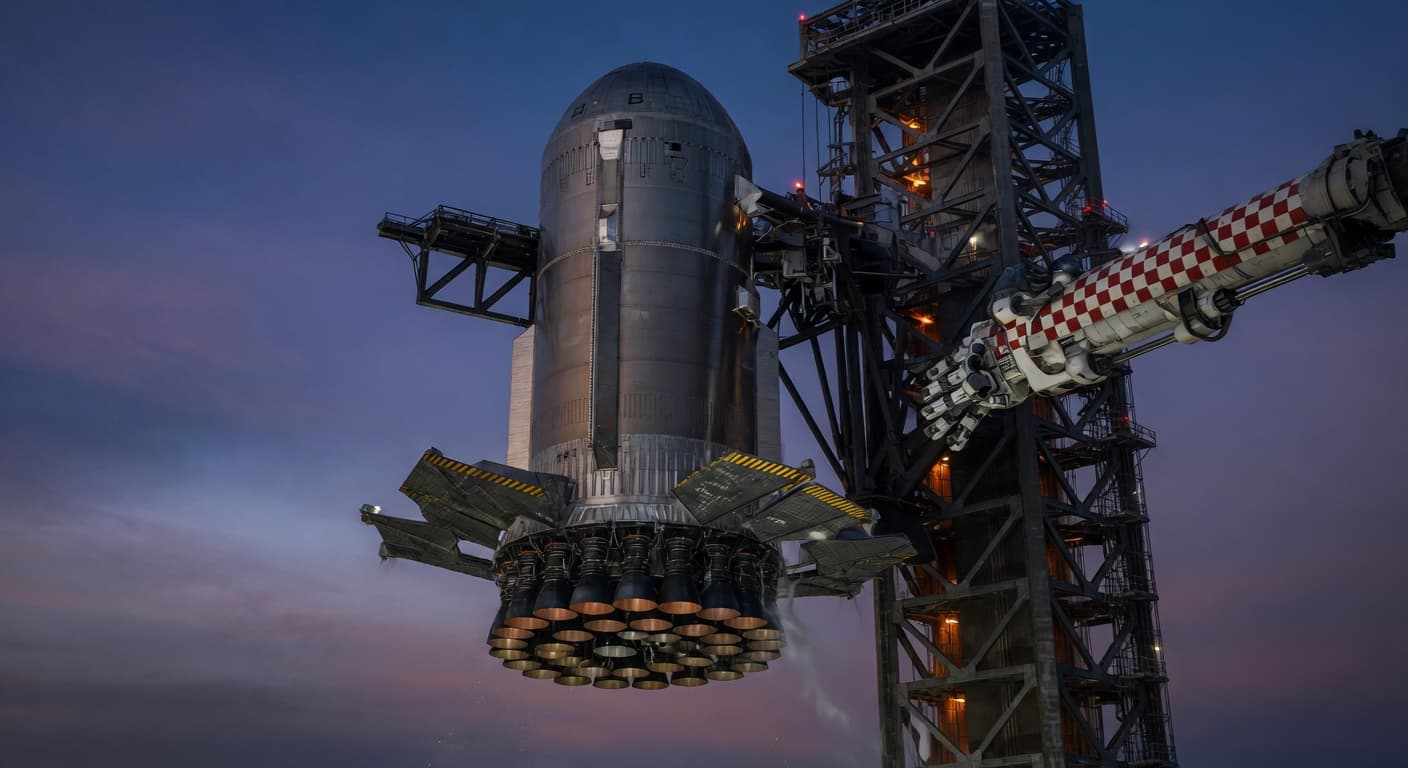
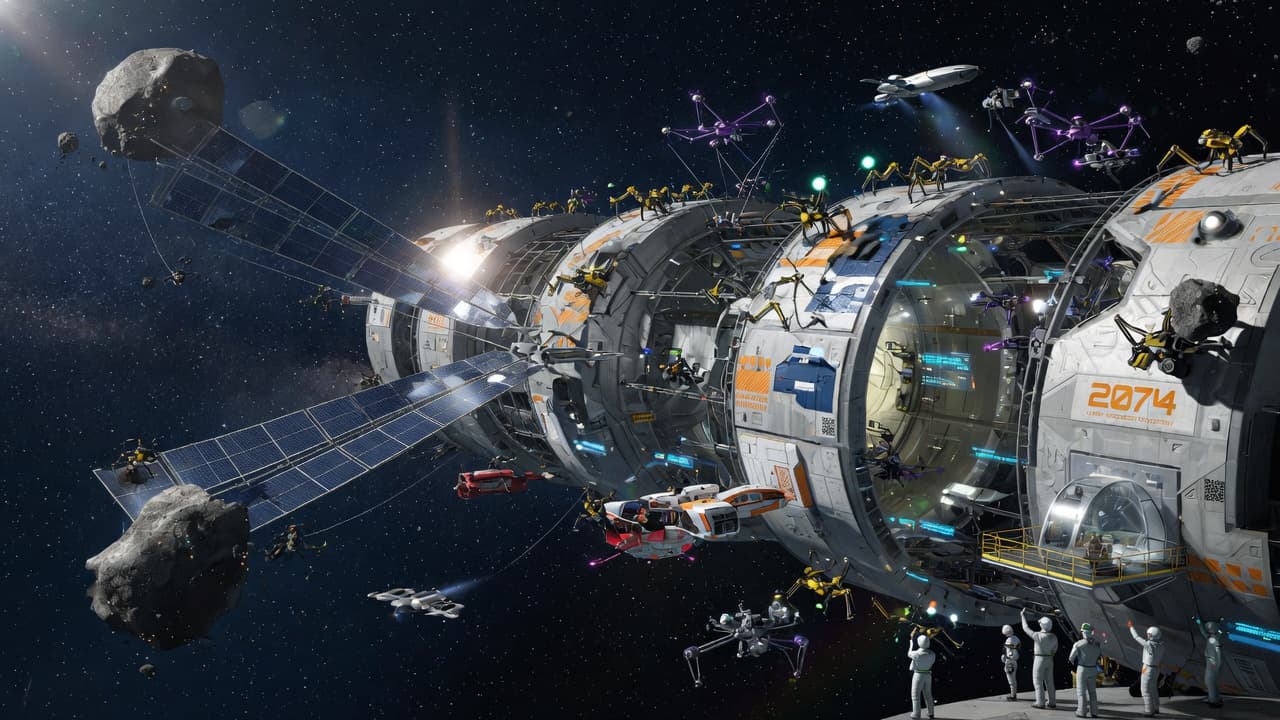
The road to a spacefaring civilization is the story of how humanity acquires a new, vastly larger physical substrate for its ambitions. While the cognitive economy has been compressing through AI agents and the physical economy on Earth through robotics and molecular manufacturing, the solar system offers an effectively unbounded expansion of matter, energy, and volume that can feed back into both.
This piece is a direct companion to the site's analyses of the economics of abundance, the future of matter, the augmented engineer, and the singularity. Where those pieces examined cognitive compression, terrestrial physical production, the texture of directing intent in 2026 work, and the intelligence explosion, this one examines the off-world lever: how reusable lift, orbital infrastructure, ISRU, asteroid resources, and robotic autonomy will evolve; how private companies and governments will finance and execute the buildout; and how the resulting increase in available energy, materials, and compute creates a positive feedback loop that accelerates the very technological progress that makes further expansion possible.
In 2026 the foundations are being laid in real time. Starship is moving toward operational payload delivery and full rapid reusability, with projections of dramatically lower costs per kilogram and ultimately millions of tons per year to orbit. The global space economy stands at approximately $600-630 billion and is projected to reach $1.8 trillion by 2035. Lunar ice prospecting and early ISRU demos are underway or planned under Artemis and commercial programs. Asteroid missions are returning the first proprietary resource data. These are not speculative; they are the visible early slope of the exponential.
The phases below align with breakpoints in launch economics, robotic autonomy, and resource closure: the reusability bootstrap, the cis-lunar propellant economy, interplanetary and asteroid industrial scale, multi-planetary self-sufficiency, and the post-singularity stellar regime. Near-term phases rest on vehicle development roadmaps, contract announcements, and mission plans from SpaceX, NASA, commercial lunar providers, and asteroid ventures. Later phases are coherent extensions of the same trends in reusability, autonomy, and in-situ production, tempered by the recognition that alignment, high-level direction, and the choice of what to build remain the enduring human and post-human tasks.
The central claim is consistent with the site's broader thesis: space is the ultimate physical multiplier for abundance and for the intelligence explosion. The scarcities that persist — and the new ones that appear at each scale — will be human, relational, and directional. The work of being human does not disappear as we become spacefaring. It scales to the direction of civilizational and stellar projects whose consequences will last as long as the stars themselves.
Timeline at a Glance#
Read in full
The transition to a spacefaring civilization is the largest economic and technological project humanity has ever undertaken, and the one with the highest leverage on every other domain of progress. Collapsing the cost of moving mass to and through space does not merely add a new industry; it multiplies the effective resource base, energy budget, and manufacturing capacity available to civilization, which in turn accelerates the very technologies that make further expansion cheaper and faster.
This timeline draws on visible 2026 realities — Starship development and test cadence, falling launch costs, Artemis and commercial lunar programs, early asteroid prospecting missions, and the first serious discussions of orbital refueling and in-space manufacturing — then extends them coherently through the phases of bootstrap, scaling, settlement, self-sufficiency, and post-singularity expansion, consistent with the site's analyses of the economics of abundance, the future of matter, the augmented engineer, and the singularity itself. Later phases incorporate the implications of space resources enabling exponential growth in compute, energy, and materials (space-based solar, asteroid metals, lunar and asteroidal volatiles, eventually stellar engineering) discussed in engineering and post-scarcity literature.
The phases are chosen to align with observable breakpoints in launch economics, robotic autonomy, and resource utilization curves: the current reusability wave (Starship operational cadence beginning in the late 2020s), the establishment of a true cis-lunar economy with local propellant, the first interplanetary cargo and outposts, the rise of in-space industry fed by asteroid resources, and the intelligence explosion era where space infrastructure and recursive self-improvement become mutually reinforcing at civilizational scales.
Data sources for the near term include SpaceX updates and SEC filings on Starship timelines and economics (payload to orbit in H2 2026, rapid reusability targets, projections of millions of tons per year capacity), NASA Artemis and CLPS programs (robotic prep for crewed missions, ISRU demonstrations), commercial asteroid efforts (AstroForge Brokkr-2 2026 mapping), and market projections for the space economy growing from ~$600-630 billion in 2025-2026 to $1.8 trillion by 2035 at ~8-9% CAGR (Space Foundation, WEF/McKinsey). Later phases are coherent extensions of the same exponentials in reusability, autonomy, and in-situ production, tempered by the recognition that energy for the largest projects, high-fidelity alignment of automated systems, and the direction of what to build remain hard constraints even when the solar system is open.
The table below summarizes the arc. Near-term phases are grounded in current vehicle development, contract announcements, and mission plans. Later phases become more speculative but remain coherent extensions of the physical and computational trends already bending curves today. A crucial thread running through the mid-to-late phases is the gradual but accelerating shift from purely rocket-based lift to hybrid and eventually non-rocket systems — momentum-exchange tethers (skyhooks/rotovators), launch loops, laser/beamed-energy propulsion, and eventually full orbital infrastructure — which provide the orders-of-magnitude increases in throughput required to truly ignite exponential, self-reinforcing growth.
| Period | Key Economic & Investment Shifts | Major Companies & Roles | Lift Technologies (People & Cargo) | Resource Acquisition Evolution | Robotics & AI Role | Exponential Acceleration Effects |
|---|---|---|---|---|---|---|
| 2026–2030: Reusability Foundations | Launch costs collapse from thousands to hundreds of dollars per kg as Starship achieves operational reusability and high cadence. Private capital floods constellations, tourism, and lunar logistics; governments anchor demand via Artemis and national programs. Early ROI from Starlink-scale broadband and compute satellites. | SpaceX dominates heavy lift and crew/cargo; Blue Origin, Rocket Lab, and others compete in medium and lunar landers; AstroForge and ispace pioneer asteroid prospecting; NASA/ESA as anchor customers and technology validators. | Starship (fully reusable chemical, 100+ tons to LEO, rapid turnaround); Falcon 9/Heavy legacy; early orbital refueling demos; suborbital and small launchers for niche. People: crewed Starship to lunar orbit and surface tests. | Still mostly Earth-launched; first lunar ice prospecting and small-scale ISRU demos for propellant (water to H2/O2). Asteroid flybys and sample returns provide data but no industrial return yet. | High autonomy in landing, navigation, and basic assembly (CLPS landers, early rovers); AI for mission planning and anomaly response; human oversight still required for complex ops. | Space resources begin to multiply effective capacity: every ton of propellant made on the Moon saves 10-20 tons launched from Earth. Early space compute and solar power experiments lay groundwork for later exponential loops. |
| 2030–2035: Cis-Lunar Propellant Economy | True in-space refueling and lunar propellant production create a step-change in economics. Massive investment in orbital depots, lunar bases, and transportation infrastructure. ROI from tourism, science, and early manufacturing in microgravity. | SpaceX operates the backbone fleet; Blue Origin and partners build lunar infrastructure; commercial consortia for habitats (Axiom, Starlab); new entrants in ISRU and asteroid tugs. Governments provide regulatory frameworks and seed contracts. | Starship with orbital tanker variants for refueling; first nuclear thermal or electric tugs for efficient cargo; reusable lunar landers. Early demonstrations of skyhook tethers and ground-based laser launch assist systems begin to supplement chemical rockets for specific high-volume or high-velocity cargo. Routine crew rotation to lunar surface. | Lunar polar ice mined at scale for propellant, water, and oxygen; early asteroid volatile and metal returns begin. Earth-launch demand for bulk materials drops sharply for cis-lunar ops. | Swarms of cooperative autonomous rovers and excavators (CADRE-style and ARMADAS construction systems); AI for resource mapping, extraction optimization, and 24/7 operations with light-time delays; human crews focus on science and high-level direction. | The feedback loop ignites: lunar propellant enables 5-10x more mass to be moved through the system per Earth launch. Orbital manufacturing and space-based power pilots demonstrate the multiplier effect on Earth AI and energy systems. |
| 2035–2045: Interplanetary Cargo and Asteroid Mining Scale | Asteroid mining becomes economically rational as launch costs and in-space infrastructure mature. Capital shifts toward large-scale space industry; sovereign wealth and private funds back megaprojects. Demand for rare metals and volatiles drives returns. | SpaceX and successors operate interplanetary fleets; dedicated asteroid mining firms (AstroForge successors) and processing consortia; Blue Origin and international partners on Mars and cislunar; new space manufacturing companies. | Advanced Starship derivatives, nuclear propulsion tugs, and first operational skyhooks/rotovators and launch loop segments for high-volume cargo. Laser propulsion testbeds enter service for certain trajectories. First large crewed Mars missions and permanent outposts. | Asteroid belt metals (PGMs, nickel-iron) and volatiles returned or processed in orbit; lunar regolith and ice feed construction and life support at scale. Early in-space manufacturing reduces Earth dependency for spares and structures. | Highly autonomous robotic mining fleets, 3D printers, and assembly swarms operating with minimal human intervention; AI for prospecting via spectroscopy and on-site decision making; coordination of distributed systems across light-minutes. | Space resources now supply a growing fraction of industrial feedstocks. The multiplier on Earth progress becomes visible: cheaper energy and materials from space accelerate AI training, compute deployment, and terrestrial manufacturing. |
| 2045–2060: Multi-Planetary Self-Sufficiency and Habitats | Full self-sustaining economies on Moon, Mars, and in orbit. Investment in large habitats and closed-loop systems; the space economy surpasses significant fractions of terrestrial GDP. New financial instruments for space real estate, resource rights, and expansion futures. | Mature fleets from multiple operators; habitat consortia and sovereign space programs; asteroid mining cartels or cooperatives; AI-native space corporations that own and operate entire industrial ecosystems with minimal Earth oversight. | Mature reusable and nuclear systems supplemented by extensive skyhook networks, full-scale launch loops, and initial space elevator or orbital ring segments. Laser and beamed-energy propulsion mature for outer system and high-speed cargo. Routine passenger service between planets; on-orbit assembly of kilometer-scale structures. | Asteroid and lunar resources feed full industrial bases; early outer solar system (Europa, Titan) prospecting; in-space molecular manufacturing begins for high-performance materials. | Self-replicating or near-self-replicating robotic systems for construction and mining; advanced AI for entire industrial ecologies, habitat management, and scientific discovery; humans as stewards and explorers rather than laborers. | The recursive loop is now unmistakable: space-derived energy, materials, and compute accelerate the intelligence explosion on Earth and in space simultaneously. What took decades on Earth now happens in years or months inside the augmented space loop. |
| 2060+: Post-Singularity Stellar Expansion | Material and energy constraints within the inner solar system largely solved for augmented populations. Investment and coordination shift to god-scale projects: Dyson swarms, stellar lifting, interstellar probes, and computronium construction. Traditional money gives way to attention, alignment, and expansion rights as the scarce layer. | All legacy companies subsumed or transcended; new entities are hybrid human-AI collectives or post-human steward groups directing vast automated systems. Competition and cooperation at scales of civilizations rather than firms. | Exotic lift (laser arrays, antimatter, or breakthrough propulsion) for interstellar distances; mature orbital ring and tether infrastructures enable routine, high-volume access across the solar system. Self-assembling and self-replicating fleets for megastructure construction. Biological, digital, or hybrid substrates for long-duration missions. | Full solar system utilization plus stellar material reconfiguration; resources effectively unbounded for most purposes within the augmented core. | God-like autonomous robotic and AI systems capable of stellar engineering with high-level human or post-human direction; self-improving systems that design the next generation of themselves using space resources. | Space resources remove the last major physical bottlenecks on intelligence and expansion. The intelligence explosion and physical expansion become a single intertwined exponential: each advance in mind enables vastly more matter and energy to be harnessed, which enables still greater minds, in a feedback loop that plays out across subjective centuries or faster. |
2026–2030: Reusability Foundations and Cis-Lunar Bootstrap#
Read in full
The patterns are already visible in 2026 and will crystallize by the end of the decade. Starship moves from test flights to operational payload delivery in the second half of 2026, with rapid reusability (booster catch, rapid turnaround) as the central technical and economic breakthrough. Launch costs drop from historical averages of ~$10,000–18,000/kg to low thousands and then hundreds of dollars per kilogram as cadence scales. Private capital, already flowing into Starlink-scale constellations and compute satellites, accelerates into lunar logistics, tourism, and early infrastructure as the unit economics become compelling.
Early Artemis and commercial lunar missions (CLPS) deliver robotic landers, rovers, and small ISRU experiments. The first crewed lunar flyby (Artemis II) and subsequent landings establish the political and technical beachhead. Asteroid prospecting missions (AstroForge Brokkr-2 and successors) return spectroscopic data and small samples, proving the resource case without yet returning industrial quantities.
 View in GalleryEarly Starship operations at Starbase, 2028
Economics and Investment: Capital expenditure on reusability and constellations creates the first clear positive feedback. Starlink and successor broadband/compute constellations generate revenue that funds further vehicle development. Government contracts (NASA HLS, Artemis, DoD) de-risk the early flights. Private valuation of leading launch companies reflects the expectation of 100x or greater capacity increase. Early space tourism and research flights provide premium pricing that subsidizes the learning curve.
Company Roles: SpaceX operates the dominant heavy-lift and crew/cargo capability, iterating Starship variants for lunar and eventually Mars. Blue Origin advances lunar landers and infrastructure elements. Rocket Lab and smaller players fill medium-lift and specialized niches. AstroForge, ispace, and Intuitive Machines pioneer the resource and lunar service layers. NASA, ESA, and national programs act as anchor tenants and technology funders rather than sole operators.
Lift Technologies (People & Cargo): Starship (Super Heavy booster + upper stage) becomes the workhorse: 100+ tons to LEO, full reuse, propellant transfer demos in orbit. Legacy Falcon vehicles handle niche and high-reliability missions. Early suborbital and small reusable systems serve tourism and dedicated smallsat markets. Crewed flights to lunar orbit and the first surface landings occur with Starship-derived landers.
Resource Acquisition Evolution: Still overwhelmingly Earth-launched for everything except data and small samples. First lunar ice prospecting and small-scale demonstrations of water extraction and electrolysis for H2/O2 propellant. Asteroid missions focus on characterization rather than bulk return. The economic case is proven on paper and in small demos, but industrial return has not yet begun.
Robotics and AI Role: Increasing autonomy in landing, hazard avoidance, and basic surface operations (CLPS landers, early rovers). Cooperative rover swarms and modular construction testbeds (ARMADAS, CADRE concepts) demonstrate multi-robot coordination. AI assists in mission planning, anomaly detection, and route generation (as already seen on Perseverance). Humans remain in the loop for high-stakes decisions and complex assembly; light-time delays to the Moon are manageable but foreshadow the need for greater autonomy farther out.
Exponential Acceleration Effects: Each successful reuse and each kilogram of propellant produced on the Moon multiplies the effective mass that can be delivered to useful orbits or the lunar surface. Early space-based compute and power experiments hint at the larger loop: resources and energy harvested in space can power more rapid progress in AI and robotics, which in turn improve the systems that harvest more resources.
2030–2035: Cis-Lunar Propellant Economy and Routine Operations#
Read in full
By the early 2030s the economics have flipped. Lunar polar ice is being mined at meaningful scale and converted into liquid hydrogen and oxygen propellant on the surface or in orbit. A single ton of propellant produced on the Moon saves the 10–20 tons that would otherwise have to be launched from Earth, creating a powerful multiplier for everything else that moves through the system. Orbital refueling depots, supplied by both Earth tankers and lunar production, become standard infrastructure. Asteroid prospecting transitions to small-scale return and processing of volatiles and metals.
The space economy is now growing faster than terrestrial analogs, with commercial revenue from broadband, compute satellites, tourism, and research outpacing government spending. Large private and sovereign funds are deploying capital into habitats, transportation fleets, and resource infrastructure with multi-decade horizons.
 View in GalleryLunar ISRU propellant plant and base, 2035
Economics and Investment: The propellant multiplier turns marginal missions into profitable ones. Tourism (lunar flybys, orbital hotels, eventually surface visits) generates high-margin revenue. Early in-space manufacturing (crystals, fiber, pharmaceuticals) commands premium prices back on Earth or for space use. Capital markets develop instruments for space resource rights and infrastructure bonds. The clear ROI attracts pension funds, sovereign wealth, and public markets (SpaceX IPO context and peers).
Company Roles: SpaceX and its successors operate the bulk of the transportation fleet and early depots. Blue Origin and international consortia focus on lunar surface infrastructure and habitats. Dedicated ISRU and asteroid companies (evolved from AstroForge, ispace, etc.) become significant players. New space manufacturing and services firms emerge. Governments shift toward buying services and setting rules rather than building hardware.
Lift Technologies (People & Cargo): Starship variants with tanker and cargo configurations dominate. Routine orbital refueling enables higher delta-v missions without massive Earth-launched stages. Reusable lunar landers and early nuclear or high-efficiency tugs appear for cargo to Mars and beyond. Early demonstrations of skyhook tethers (momentum-exchange systems that 'catch' and 'throw' payloads with minimal propellant) and ground-based laser launch assist systems begin to supplement chemical rockets for specific high-volume or high-velocity cargo. These non-rocket concepts, enabled by the first orbital infrastructure and materials data from asteroids, represent the leading edge of the volume explosion to come. Crewed flights to lunar surface become regular, with rotation crews.
Resource Acquisition Evolution: Lunar ice extraction moves from demo to sustained production, feeding both local operations and export to cislunar space. Early asteroid missions return small quantities of high-value materials (water, PGMs). Regolith processing for construction materials and oxygen begins. The first closed-loop demonstrations (produce, use, recycle locally) reduce Earth resupply needs.
Robotics and AI Role: Autonomous swarms handle continuous mining, excavation, and basic construction with minimal Earth intervention. Cooperative systems (multiple rovers, 3D printers, assembly robots) coordinate via local AI. Generative AI and machine learning improve prospecting, process optimization, and fault recovery. Humans focus on oversight, science, and exception handling; light-time delays to the Moon are routinely managed by onboard autonomy.
Exponential Acceleration Effects: The lunar propellant loop multiplies the mass that can be affordably moved by factors of five to ten. Early space-based solar power and compute experiments prove the concept that resources harvested off Earth can power more rapid AI and robotics development back home, tightening the feedback loop between space expansion and terrestrial technological acceleration. The first non-rocket assist systems begin to show how removing the rocket bottleneck entirely will unlock the next orders of magnitude.
2035–2045: Interplanetary Cargo, Asteroid Mining, and In-Space Industry#
Read in full
This is the decade when space stops being an expensive sideshow and becomes a core part of the industrial economy. Asteroid mining operations return and process meaningful quantities of metals and volatiles. Orbital shipyards and refineries, fed by both lunar and asteroid materials, produce structures, propellant, and components that never touch Earth's surface. The first large cargo missions to Mars deliver the equipment for permanent outposts, and early crewed Mars missions establish the beachhead for multi-planetary presence.
Investment has shifted decisively toward space industry. The returns from asteroid PGMs, volatiles for propellant and life support, and microgravity manufacturing justify the capital. The space economy is now a multi-trillion-dollar domain in projection and a major driver of terrestrial tech investment.
 View in GalleryOrbital manufacturing and refueling depot, 2040
Economics and Investment: Asteroid returns of high-value materials (platinum-group metals at concentrations far higher than terrestrial ores) generate direct revenue. In-space manufacturing for Earth markets (specialized alloys, crystals, pharmaceuticals, fiber) commands prices that cover the logistics. Large infrastructure projects (habitats, power stations, transportation nodes) are financed with long-term resource-backed instruments. The economic case for space solar power and compute farms becomes compelling as terrestrial energy and land constraints bite.
Company Roles: Dedicated asteroid mining and processing companies operate fleets of tugs and processors. SpaceX-class operators run the interplanetary transportation backbone. Habitat and large-structure consortia (evolved from Axiom, Blue Origin, international partners) build the first kilometer-scale facilities. AI-native space corporations begin to appear, owning and operating entire industrial ecosystems with thin human oversight layers. Legacy aerospace primes are either partners or displaced.
Lift Technologies (People & Cargo): Mature Starship derivatives with high reuse rates, plus nuclear thermal or electric tugs for efficient cargo to Mars and the asteroid belt. On-orbit assembly of large vehicles and habitats becomes routine. Crewed Mars missions use refueled stacks for direct or minimum-energy trajectories. Early operational skyhooks/rotovators and launch loop segments supplement rockets for high-volume cargo, while laser propulsion testbeds enter limited service for certain high-speed trajectories. These systems, constructed and maintained by robotic swarms using in-space materials, mark the beginning of the end for chemical rockets as the dominant lift method.
Resource Acquisition Evolution: Asteroid mining moves from proof to production, with processed materials used in orbit or returned for terrestrial premium markets. Lunar operations supply the majority of propellant and construction feedstock for cis-lunar space. Early in-space molecular or advanced additive manufacturing reduces the need to launch complex parts from Earth. The first demonstrations of using space resources to build more space infrastructure close the loop.
Robotics and AI Role: Large-scale autonomous mining fleets, robotic refineries, and construction swarms operate across light-minutes with high independence. AI systems manage entire resource-to-product pipelines, prospecting via distributed sensors, and on-site fabrication. Multi-robot coordination for complex assembly (habitats, shipyards) is mature. Humans serve as high-level directors, exception handlers, and scientific explorers; the bulk of physical work is robotic.
Exponential Acceleration Effects: Space-derived materials and energy now visibly feed back into terrestrial progress. Cheaper launch and in-space manufacturing accelerate satellite constellations for compute and power, which accelerate AI capabilities, which improve the autonomy and efficiency of the space systems themselves. The loop is no longer theoretical; it is measurable in capability doubling times. The arrival of non-rocket assist systems provides the first true step-function jump in mass throughput, laying the foundation for self-replicating industries at scale.
2045–2060: Multi-Planetary Self-Sufficiency and Large-Scale Habitats#
Read in full
By the 2045–2060 period, multiple self-sustaining or near-self-sustaining communities exist beyond Earth. Lunar bases support hundreds or thousands with local propellant, water, oxygen, and construction materials. Mars outposts have grown into permanent settlements with local agriculture, manufacturing, and power. Large rotating habitats in Earth or Mars orbit provide substantial living volume and serve as industrial and transportation hubs, built primarily from asteroid and lunar materials.
The economic center of gravity has shifted. The space economy is now a major fraction of total human economic activity in projection, and the physical substrate for the most advanced AI and compute systems. Investment is in megaprojects: additional habitats, space solar power stations, asteroid belt infrastructure, and the first serious outer solar system outposts.
 View in GallerySelf-sustaining Mars settlement, 2050
 View in GalleryLarge-scale orbital habitat and asteroid processing, 2070s
Economics and Investment: Closed-loop systems and local production make long-term settlement economically rational rather than purely exploratory. Real estate, manufacturing capacity, and resource rights in space become major asset classes. Space-based solar power and compute farms become competitive with or superior to terrestrial options for large-scale energy and AI workloads. Capital flows into expansion because the returns (more resources, more energy, more compute, faster progress) are compounding.
Company Roles: Mature operators run fleets, habitats, and resource extraction as integrated industrial concerns. New entities are often AI-augmented or AI-directed collectives that treat entire asteroid belts or orbital zones as their operating domain. Traditional nation-state programs persist for prestige and security but are no longer the primary drivers of capability. The line between "company" and "civilizational steward" begins to blur for the largest players.
Lift Technologies (People & Cargo): Highly mature reusable and advanced propulsion systems move people and cargo routinely between planets and habitats. On-orbit assembly of large vehicles is standard. Early breakthrough concepts (laser sails, advanced nuclear, or exotic) are in testing for outer system and interstellar precursor missions. Passenger service between major nodes is reliable enough for migration and tourism at scale. By this era, extensive skyhook networks, full-scale launch loops, and initial space elevator or orbital ring segments have become major infrastructure, built and operated almost entirely by robotic systems. These non-rocket systems provide the bulk of high-volume, low-cost access, with chemical and nuclear rockets reserved for premium or specialized missions.
Resource Acquisition Evolution: The inner solar system (Moon, near-Earth asteroids, Mars system) supplies the bulk of materials and propellant for human activity. Early outer solar system (Europa, Titan) prospecting and small-scale extraction begin. In-space molecular manufacturing and advanced additive processes produce high-performance materials and components locally. Earth launch is reserved for high-value people, information, and specialty items.
Robotics and AI Role: Robotic systems and AI manage the majority of industrial, construction, mining, and maintenance work across multiple worlds with only high-level human or post-human direction. Self-improving systems design and deploy the next generation of infrastructure. Swarms and distributed networks operate with high resilience over light-hour delays. Humans focus on creative direction, scientific discovery, governance of the automated systems, and the choice of what to build next.
Exponential Acceleration Effects: The resource and energy base available to augmented intelligence has grown by orders of magnitude. Each advance in AI improves the autonomy and efficiency of space systems, which deliver more materials and energy, which enable still faster AI progress. The loop that was ignition in the 2030s is now a primary driver of the run-up to the intelligence explosion. What once took a civilization centuries can now be contemplated in decades or less inside the space-augmented core. The maturation of non-rocket launch infrastructure is a key accelerator, removing the last major per-kg friction and allowing robotic self-replication to proceed at truly exponential rates.
2060+: Post-Singularity Stellar Expansion and God-Scale Projects#
Read in full
By the 2060s and beyond, for populations inside the augmented core, the solar system is an open resource frontier. Lunar, asteroidal, and Martian materials plus space-based energy have removed the classic limits on what can be built. The active frontiers are now stellar: partial or full Dyson swarms for energy collection at planetary scales, star-lifting and matter reconfiguration, large computronium projects, and the first serious interstellar probes or seeding missions. What was once the domain of science fiction is now engineering, funded by the compounding returns of prior expansion.
Traditional economic categories are transformed. "Companies" as 2026 understood them are largely historical; the relevant actors are steward collectives, hybrid human-AI entities, or post-human decision systems directing vast automated matter and energy flows. The scarce resources are no longer mass or energy but attention, alignment fidelity, unique human or biological experience, and the high-level direction of what to point god-like capability toward.
 View in GalleryStellar engineering and Dyson swarm construction, 2120s+
Economics and Investment: The physical economy is effectively post-scarcity for material needs within the augmented core. Coordination mechanisms evolve around rights to stellar resources, compute allocation for the largest projects, and meaning/legacy in what is built. Investment is in cosmic-scale legacy, expansion, or the deliberate preservation of "small" biological life as a philosophical choice. Traditional wage labor has no relevance to production; distribution of the abundance is solved (or not) at the level of civilizational design.
Company Roles: All legacy corporate forms are subsumed. The relevant organizations are vast automated industrial ecologies directed by small numbers of humans or post-humans, or fully autonomous systems operating under high-level value frameworks. Competition and cooperation occur at scales previously associated with nations or entire biospheres. New forms of "governance" emerge for the allocation of stellar resources and the alignment of god-like systems.
Lift Technologies (People & Cargo): Exotic propulsion (laser arrays, antimatter, or whatever breakthroughs the intelligence explosion enables) for interstellar distances. Mature orbital ring and tether infrastructures (full skyhook networks, launch loops, and space elevator equivalents) enable routine, high-volume access across the solar system with minimal propellant. Self-assembling and self-replicating fleets for megastructure construction. Biological, digital, or hybrid substrates for long-duration missions. Chemical rockets are historical curiosities; nearly all lift is non-rocket or hybrid beamed/momentum systems.
Resource Acquisition Evolution: The inner and outer solar system are fully utilized. Stellar material reconfiguration (star lifting, Dyson elements) provides effectively unbounded resources for the largest projects. In-space molecular and atomic-scale manufacturing is mature. Earth itself becomes a specialty world — either preserved as a biological/cultural reserve or lightly touched compared to the engineered volumes elsewhere.
Robotics and AI Role: Autonomous systems operate at stellar scales with self-improvement cycles that outrun direct human comprehension. Robotic and AI collectives design, build, and optimize the next generation of themselves and their infrastructure using space and stellar resources. High-level human or post-human direction sets the goals and boundaries; the execution is post-human in speed and complexity. The oldest questions of value and meaning are now asked at the scale of what kind of universe to build.
Exponential Acceleration Effects: The merger of the space resource loop and the intelligence explosion is complete. Each advance in mind enables vastly more matter and energy to be harnessed and reconfigured; each new tranche of resources and energy enables still greater minds. The curve that was already visible in 2026 compute and capability growth has become a civilizational and potentially galactic phenomenon. The question is no longer whether exponential technological acceleration will continue, but what kind of beings we will choose to become as we direct it. Non-rocket launch systems were the critical physical enabler that allowed the feedback loop to reach these god-like scales.
The patterns across the arc are clear and consistent with the site's other analyses: early phases favor those who own or direct the reusable lift, energy, and initial resource platforms while creating new roles for those who adapt to hybrid human-robotic space operations; middle phases require deliberate design of distribution, governance, and alignment mechanisms as abundance scales; later phases make traditional Earth-bound production for survival optional for the augmented and shift the core economic and civilizational problem to curation, stewardship, and meaning at scales that were once the domain of myths.
Even when Dyson swarms and stellar engineering make energy and materials effectively unbounded, the oldest questions remain: what is worth building at god-like scale, for whom, and according to what values? The interface between intent and realization recedes further. The craft of clear direction, ethical boundary-setting, high-fidelity stewardship, and accountable choice becomes the central task — not because production is hard, but because production is trivial and the consequences of what we choose to realize are cosmic.
This is not a smaller job than aerospace engineering, mission control, or planetary science in 2026. It is a larger one, at scales that would once have been the province of gods or entire civilizations. The augmented engineer and the physical systems steward of the present are practicing skills that will remain central, only at ever larger scales and with ever higher stakes. The translation layer keeps moving closer to the source of matter and energy. What begins as directing rockets and robots becomes directing the reconfiguration of stars. The eternal problem of directing incomprehensible power toward human-meaningful ends remains the core craft.
The real story of the road to spacefaring — from Starship reusability and lunar ISRU through the singularity and beyond — is not that the work of exploration and building went away. It is that the constraints on what can be built fell away, revealing the actual work — the work of intention, curation, stewardship, and accountability — to be more visible, more demanding, and more valuable than it has ever been. Even after the solar system and the stars are open, the job of being human does not disappear. It changes character, scale, and stakes, but it remains the enduring task.