The perception that Operation Epic Fury has stalled, or that decisive action has given way to hesitation, fundamentally misreads the situation. What looks like delay from the outside is better understood as a deliberate transition in a multi-phase campaign. The United States and its partners have already inflicted severe damage on Iran's military capabilities and leadership structure. The current phase — marked by a fragile ceasefire, economic pressure via blockade, and active negotiations — reflects calculated leverage rather than confusion or weakness.
To grasp why things have unfolded this way, we must examine the military, economic, internal Iranian, and diplomatic layers together. Surface-level narratives ("why not strike harder?" or "why the pause?") miss the deeper game.
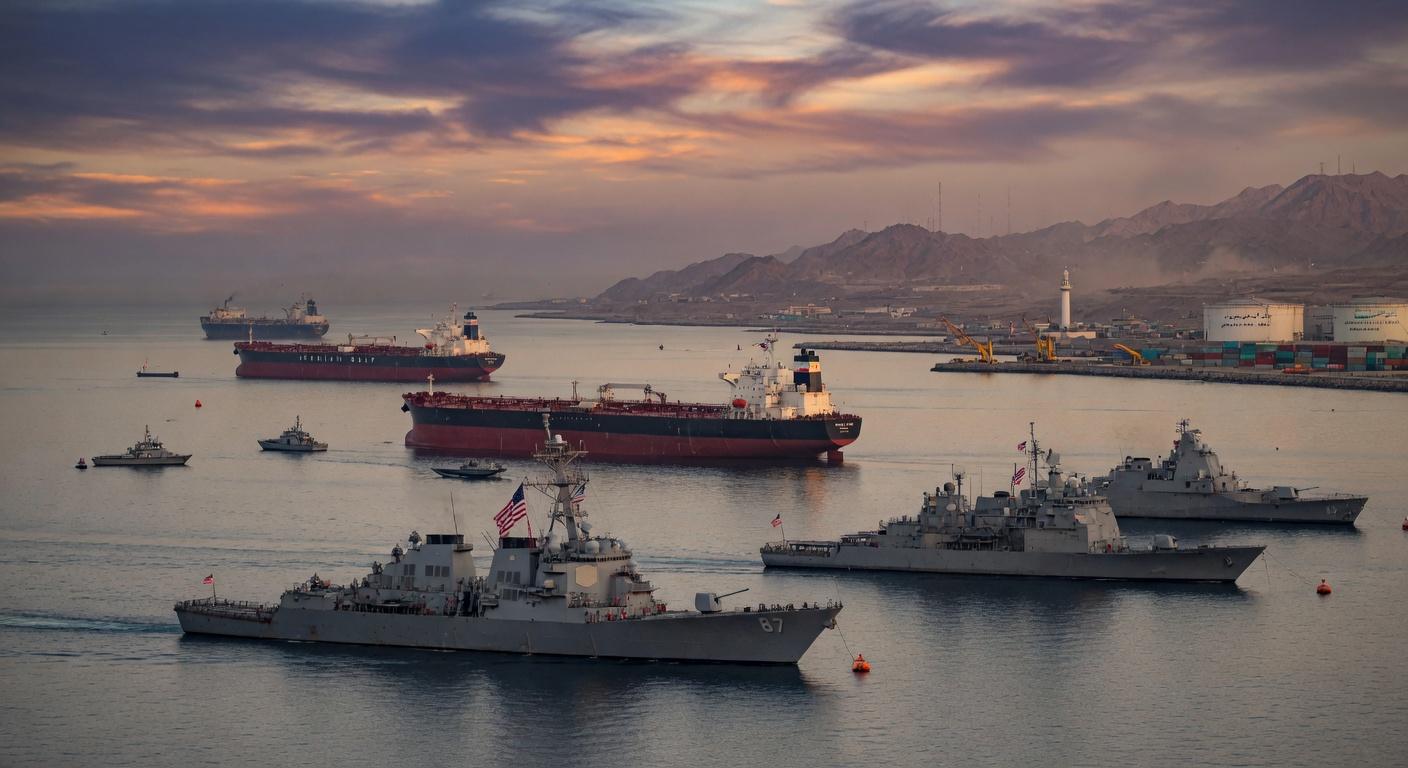
 View in GalleryUS naval presence enforcing the strategic blockade in the Persian Gulf at twilight
US Navy surface combatants and support vessels maintaining the targeted naval blockade of Iranian ports in the Persian Gulf at twilight — the sustained economic instrument of leverage during the pause in major combat operations.
View in GalleryUS naval presence enforcing the strategic blockade in the Persian Gulf at twilight
US Navy surface combatants and support vessels maintaining the targeted naval blockade of Iranian ports in the Persian Gulf at twilight — the sustained economic instrument of leverage during the pause in major combat operations.
The Nuclear Threshold: How Enrichment Works, How It Is Verified, and Why 60% Cannot Be for Peaceful Purposes#
Read in full
The technical difficulty of enrichment decreases sharply as the concentration rises. Reaching 20% already represents the large majority of the effort required to produce weapons-usable material. Moving from 20% to 60% is a major additional step, but the final jump from 60% to 90% is relatively easy and fast with existing advanced centrifuges (particularly Iran's IR-6 models). A stockpile at 60% therefore places a state within days or weeks of being able to produce enough weapons-grade uranium for multiple bombs.
How the facts are established
Claims about Iran's enrichment levels come primarily from the International Atomic Energy Agency (IAEA), the world's nuclear watchdog. IAEA inspectors conduct on-site visits, install cameras and seals, use online enrichment monitors, and — most importantly — collect environmental samples by swiping surfaces inside declared facilities. These microscopic particles are analyzed in IAEA laboratories using mass spectrometry, which can determine the precise enrichment level even from tiny traces. The agency also verifies centrifuge counts, feed and withdrawal records, and material balances.
In Iran's case, IAEA quarterly reports have repeatedly documented the exact quantities of uranium at each enrichment level. As of mid-May 2025, Iran had accumulated roughly 440 kilograms (U mass) of uranium hexafluoride enriched up to 60% — enough, if further enriched, for material equivalent to approximately nine to ten nuclear weapons. Environmental sampling has also revealed particles enriched well above declared levels on multiple occasions.
National intelligence (particularly from the United States and Israel) supplements IAEA data with satellite imagery, human sources, and signals intelligence, especially regarding undeclared sites or activities. After the June 2025 strikes, IAEA inspector access was severely restricted or withdrawn, shifting greater reliance onto prior baseline data and overhead imagery.
Why 60% enrichment has no plausible peaceful justification
No commercial nuclear power reactor in the world uses fuel enriched to 60%. Iran's own Bushehr power reactor runs on 3–5% LEU. Its Tehran Research Reactor, used for medical isotope production, requires only small quantities of 20% material for targets. Iran's rate of 60% production in 2025 (tens of kilograms per month at peak) vastly exceeded any realistic civilian need for that reactor.
The IAEA has stated explicitly that Iran has "no civilian use or justification" for producing and stockpiling uranium enriched to 60% at this scale. Iran is the only non-nuclear-weapon state doing so. While Iranian officials have occasionally floated vague justifications (future research reactors or medical isotopes), these claims do not withstand technical scrutiny. The combination of enrichment level, stockpile size, and production rate had no credible non-weapons application.
This is why the rapid growth of Iran's 60% stockpile in spring 2025 — occurring while indirect nuclear negotiations with the United States were underway — was treated as an urgent threshold-crossing event.
Timeline at a Glance#
Read in full
| Period | Military & Strikes | Economic & Blockade | Diplomacy & Negotiations | Iranian Regime Dynamics | Nuclear Program |
|---|---|---|---|---|---|
| Spring–May 2025 | Limited direct action; focus on proxies | None | Indirect US-Iran talks (Oman/Rome rounds); some progress reported by mediators | Khamenei still Supreme Leader; IRGC and hardliners dominant | Rapid enrichment to 60% U-235 accelerates in parallel with talks; stockpile reaches ~440 kg (material for ~9–10 weapons if further enriched); IAEA publicly flags unprecedented proliferation risk |
| June 13–21, 2025 | Israeli strikes on nuclear sites + leadership (start of Twelve-Day War); US strikes Fordow, Natanz, Isfahan | None | Planned next talks round canceled | Senior leaders killed; command disruption | Major damage to enrichment infrastructure; 60% stockpile largely survives (pre-positioned in Isfahan tunnels); breakout time extended to 9–12 months per US intel |
| Feb 6–28, 2026 | Force buildup and positioning | None | New Geneva/Oman talks round; mediators claim "significant progress"; core gaps persist | — | Remaining nuclear capacity and stockpile still a central concern |
| Feb 28, 2026 | Operation Epic Fury (US) / Roaring Lion (Israel) launches with massive opening salvo | None | Diplomacy collapses; military campaign begins | Supreme Leader Ali Khamenei killed in opening hours; immediate power vacuum | Nuclear facilities again heavily targeted as priority |
| Early April 2026 | Major combat phase ends; low-intensity follow-ons begin | None | Ceasefire agreed (initial 2-week term) | Fractured leadership; Mojtaba Khamenei installed as Supreme Leader (largely figurehead) | — |
| Mid-April 2026 | Targeted responses to provocations continue | Targeted naval blockade of Iranian ports imposed (not full Hormuz closure) | — | IRGC and security council hardliners consolidate real power | — |
| April 21, 2026 | — | Blockade maintained as primary ongoing lever | Ceasefire extended indefinitely by Trump | — | — |
| May 4–5, 2026 | Limited clashes (Iranian speedboats engaged during escort attempts) | Blockade remains in full effect | "Project Freedom" ship-escort operation launched, meets resistance, abruptly paused by Trump in <48 hours citing negotiation progress | — | — |
| Late May–early June 2026 | Occasional calibrated responses | Blockade continues as central economic pressure tool | MOU/ceasefire extension talks ongoing; major sticking points on verification, sequencing, and proxies | IRGC/security inner circle dominant; decision-making more collective and hardline | Signals of limited reconstitution; stockpile and technical knowledge intact |
Spring–May 2025#
Military & Strikes#
Limited direct action; focus on proxies
Economic & Blockade#
None
Diplomacy & Negotiations#
Indirect US-Iran talks (Oman/Rome rounds); some progress reported by mediators
Nuclear Program#
Rapid enrichment to 60% U-235 accelerates in parallel with talks; stockpile reaches ~440 kg (material for ~9–10 weapons if further enriched); IAEA publicly flags unprecedented proliferation risk
June 13–21, 2025#
Military & Strikes#
Israeli strikes on nuclear sites + leadership (start of Twelve-Day War); US strikes Fordow, Natanz, Isfahan
Economic & Blockade#
None
Diplomacy & Negotiations#
Planned next talks round canceled
Iranian Regime Dynamics#
Senior leaders killed; command disruption
Nuclear Program#
Major damage to enrichment infrastructure; 60% stockpile largely survives (pre-positioned in Isfahan tunnels); breakout time extended to 9–12 months per US intel
Feb 6–28, 2026#
Military & Strikes#
Force buildup and positioning
Economic & Blockade#
None
Diplomacy & Negotiations#
New Geneva/Oman talks round; mediators claim "significant progress"; core gaps persist
Iranian Regime Dynamics#
—
Nuclear Program#
Remaining nuclear capacity and stockpile still a central concern
Feb 28, 2026#
Military & Strikes#
Operation Epic Fury (US) / Roaring Lion (Israel) launches with massive opening salvo
Economic & Blockade#
None
Diplomacy & Negotiations#
Diplomacy collapses; military campaign begins
Iranian Regime Dynamics#
Supreme Leader Ali Khamenei killed in opening hours; immediate power vacuum
Nuclear Program#
Nuclear facilities again heavily targeted as priority
Early April 2026#
Military & Strikes#
Major combat phase ends; low-intensity follow-ons begin
Economic & Blockade#
None
Diplomacy & Negotiations#
Ceasefire agreed (initial 2-week term)
Iranian Regime Dynamics#
Fractured leadership; Mojtaba Khamenei installed as Supreme Leader (largely figurehead)
Nuclear Program#
—
Mid-April 2026#
Military & Strikes#
Targeted responses to provocations continue
Economic & Blockade#
Targeted naval blockade of Iranian ports imposed (not full Hormuz closure)
Diplomacy & Negotiations#
—
Iranian Regime Dynamics#
IRGC and security council hardliners consolidate real power
Nuclear Program#
—
April 21, 2026#
Military & Strikes#
—
Economic & Blockade#
Blockade maintained as primary ongoing lever
Diplomacy & Negotiations#
Ceasefire extended indefinitely by Trump
Iranian Regime Dynamics#
—
Nuclear Program#
—
May 4–5, 2026#
Military & Strikes#
Limited clashes (Iranian speedboats engaged during escort attempts)
Economic & Blockade#
Blockade remains in full effect
Diplomacy & Negotiations#
"Project Freedom" ship-escort operation launched, meets resistance, abruptly paused by Trump in <48 hours citing negotiation progress
Iranian Regime Dynamics#
—
Nuclear Program#
—
Late May–early June 2026#
Military & Strikes#
Occasional calibrated responses
Economic & Blockade#
Blockade continues as central economic pressure tool
Diplomacy & Negotiations#
MOU/ceasefire extension talks ongoing; major sticking points on verification, sequencing, and proxies
Iranian Regime Dynamics#
IRGC/security inner circle dominant; decision-making more collective and hardline
Nuclear Program#
Signals of limited reconstitution; stockpile and technical knowledge intact
This timeline illustrates the deliberate, multi-layered campaign: military degradation paired with sustained economic coercion, active diplomacy, and exploitation of Iranian internal fractures — all while the nuclear threshold remained a core driver.
Military Phase: Significant Degradation, Clear Limits#
Read in full
- Supreme Leader Ali Khamenei and numerous senior officials (leadership decapitation).
- Nuclear facilities and remaining enrichment infrastructure (building on the damage from the 2025 strikes).
- Ballistic missile production, storage, and launch sites.
- Air defense systems, enabling localized air superiority.
- IRGC naval and security assets.
U.S. objectives, articulated by Secretary of War Pete Hegseth and others, were focused: destroy offensive missiles and production capacity, neutralize the navy and related threats, and ensure Iran cannot acquire nuclear weapons. By early May, statements from Secretary of State Marco Rubio and President Trump indicated the major combat phase had met its core military aims, paving the way for a ceasefire around April 8.
 View in GalleryPrecision airstrikes on Iranian ballistic missile and nuclear facilities during Operation Epic Fury
Precision strikes under Operation Epic Fury targeted ballistic missile production, storage, launch sites, nuclear infrastructure, and leadership nodes across Iran's interior and coast.
View in GalleryPrecision airstrikes on Iranian ballistic missile and nuclear facilities during Operation Epic Fury
Precision strikes under Operation Epic Fury targeted ballistic missile production, storage, launch sites, nuclear infrastructure, and leadership nodes across Iran's interior and coast.
Yet limits exist. Iran retains asymmetric tools through proxies (though their capacity is degraded). Retaliatory missile and drone barrages caused real damage and casualties across the region. Reports of civilian harm, including strikes near populated areas, underscore the inherent messiness of high-intensity air campaigns. Full regime change was never the primary U.S. stated goal in the same explicit way some Israeli voices may have framed it; the emphasis stayed on capability denial and restored deterrence.
The "chip away" dynamic — responding to Iranian provocations with targeted follow-on actions — has continued at lower intensity. This maintains pressure and credibility without locking into unsustainable escalation or ground commitments.
The Blockade: Economic Warfare as the Sustained Lever#
Read in full
The effects were substantial. Iranian oil export revenue — critical for regime finances, military funding, and proxy support — took a severe hit. Daily economic losses ran into the hundreds of millions according to various estimates. Over 100 vessels were redirected, demonstrating credible enforcement. This created asymmetric pressure: relatively low ongoing cost and risk for the U.S. and partners, existential strain for Tehran.
 View in GalleryUS Navy destroyer interdicting Iranian oil tanker during Gulf blockade
US Navy guided-missile destroyer conducting interdiction operations against an Iranian-flagged tanker near Bandar Abbas — the blockade's precise application of economic pressure without broader Hormuz closure.
View in GalleryUS Navy destroyer interdicting Iranian oil tanker during Gulf blockade
US Navy guided-missile destroyer conducting interdiction operations against an Iranian-flagged tanker near Bandar Abbas — the blockade's precise application of economic pressure without broader Hormuz closure.
The blockade complemented the military campaign perfectly. Strikes degrade physical assets; sustained economic denial starves the ability to rebuild or sustain operations. It is classic maximum-pressure economics backed by military power.
Recent signals show this tool transitioning from pure coercion to bargaining chip. President Trump has publicly indicated the blockade "will now be lifted" in the context of advancing deal terms, with implementation potentially phased in proportion to restored traffic. This is not capitulation but the logical shift from punishment to incentive once sufficient leverage exists.
Iranian Internal Fractures: A Critical but Under-Discussed Factor#
Read in full
 View in GalleryIRGC commanders in strategic operations center amid post-Khamenei power consolidation
IRGC leadership in a command center, with regional maps and missile systems on display, as the Guard consolidates authority in the vacuum left by the Supreme Leader's elimination.
View in GalleryIRGC commanders in strategic operations center amid post-Khamenei power consolidation
IRGC leadership in a command center, with regional maps and missile systems on display, as the Guard consolidates authority in the vacuum left by the Supreme Leader's elimination.
This shift has several implications:
- Hardliners vs. Pragmatists: Security elements tied to the IRGC may favor prolonged resistance or escalation to preserve power and ideology. More pragmatic voices may see the need for an off-ramp to prevent total system collapse.
- Decision Paralysis: Fragmented authority can slow coherent response or make unified resistance harder.
- Exploitable Window: External pressure can amplify internal tensions, making a face-saving deal more attractive to those who want the regime to survive in some form.
U.S. and Israeli strategy almost certainly factors in these fractures — through intelligence, signaling, and possibly covert actions targeting elite dynamics. Treating Iran as a monolithic actor misses this reality.
These internal power realities are shaped by something deeper than normal factional politics. The men now dominant in the IRGC and security structures operate within a specific ideological and religious framework that changes how they calculate risk, cost, and acceptable outcomes. That framework is addressed in the following section.
The Apocalyptic Worldview#
Read in full
The men who control Iran's security apparatus and nuclear decisions do not think like conventional state actors. Their worldview is rooted in a specific interpretation of Twelver Shia eschatology centered on the Hidden Imam (the Twelfth Imam, or Mahdi) and the revolutionary doctrine of velayat-e faqih (guardianship of the Islamic jurist).
In this framework, the Supreme Leader rules as the deputy of the Hidden Imam until his return. The return of the Mahdi is not a distant hope but an active horizon: a final reckoning in which the forces of oppression will be destroyed and justice established over the earth. A significant current within the clerical and IRGC establishment views major upheaval — regional war, economic ruin, even the physical destruction of large parts of the current Iranian state — not as catastrophe to be avoided, but as the necessary "birth pangs" of redemption.
 View in GalleryThe Mahdi Gives Thumbs Up
The mullahs finally witness the return of the Mahdi after triggering the apocalypse. The redeemer gives them a big thumbs-up for a job well done.
View in GalleryThe Mahdi Gives Thumbs Up
The mullahs finally witness the return of the Mahdi after triggering the apocalypse. The redeemer gives them a big thumbs-up for a job well done.
This is not fringe theology for the people who matter. It has shaped public rhetoric for decades. The constant, explicit threats — "Death to America," "Death to Israel," "Israel must be wiped off the map" — repeated by Supreme Leaders and presidents alike, and painted on IRGC missiles, are not mere propaganda. They express a religiously framed duty to confront the "arrogant powers." Under Mahmoud Ahmadinejad, this language moved from the shrines directly into state policy, with open talk of preparing the ground for the Mahdi's imminent return.
The practical result is a leadership that can treat enormous costs, including the potential martyrdom of the regime itself, as acceptable or even spiritually meaningful. Suffering is reframed as sacred. National ruin can be recast as a necessary stage rather than defeat. The willingness to absorb pain that would break a normal state is treated as proof of revolutionary authenticity.
 View in GalleryThe Ayatollah Watches the End
The Supreme Leader watches the world end from the safety of his spaceship — visibly pleased.
View in GalleryThe Ayatollah Watches the End
The Supreme Leader watches the world end from the safety of his spaceship — visibly pleased.
This is why the current situation is not a standard negotiation between rational actors who ultimately want to preserve their power and avoid catastrophe. The individuals and institutions that matter most in Tehran operate from a different set of fundamental assumptions about history, sacrifice, and the acceptability of apocalyptic outcomes.
For the full treatment of this ideology — its theological roots, its historical development, and its consequences — see the companion essay The Regime That Devours Its Own, especially the sections on the Theology of Rule and the regime's nuclear behavior.
Trump's Consistent Strategic Pattern#
Read in full
- Build Maximum Leverage First: Withdrawal from the JCPOA, the Soleimani strike, and now Epic Fury plus blockade — all serve to create negotiating power from a position of strength.
- Avoid Open-Ended Quagmires: Despite rhetoric, there is clear aversion to nation-building or indefinite ground occupations. The focus on capability destruction, economic denial, and then negotiation aligns with "peace through strength" without the costs of endless war.
- Maintain Credible Threat and Unpredictability: Keeping the option for resumed operations (and using targeted responses) prevents the adversary from settling into comfortable resistance.
- Transactional Endgame: The goal is a deal securing core interests (no nuclear breakout path, open energy lanes, constrained proxy support) rather than total capitulation or ideological transformation.
The deep Israel partnership amplifies reach. Public confidence in statements ("Iran negotiating on fumes," military and economy crippled) serves domestic base consolidation and international signaling. Midterm considerations (desire for a clear "win" narrative without quagmire optics) likely play a supporting role.
The "surprise" and "covert" elements noted in analysis are real. Significant unseen operations, intelligence advantages, and coordinated pressure almost certainly exist beyond public strikes.
Current Negotiations: Terms, Leverage, and Friction#
Read in full
Iranian commitments:
- Permanent renunciation of nuclear weapons capability.
- Full, immediate, and unrestricted reopening of the Strait of Hormuz (no tolls, mines cleared).
- Cooperation on locating, securing, and destroying or accounting for highly enriched uranium stockpiles.
U.S. reciprocity:
- Phased or conditional lifting of the naval blockade.
- Some sanctions relief or waivers to permit oil sales.
- No immediate large-scale cash transfers or unfreezing of funds without further progress.
- Framework for extended talks on remaining issues (verification, regional security, etc.).
Sticking points are predictable: verification mechanisms and access for nuclear-related sites, scope and timing of sanctions relief, handling of proxy networks, and Iranian desires for broader recognition or economic guarantees.
The U.S. position is strong on paper: significant military degradation achieved, economic distress imposed, and a credible threat of resumed force if terms are not met. Iran is weakened but retains some retaliatory options and can play for time or internal consolidation. The abrupt pause of Project Freedom in early May illustrated both the leverage available and the risks of pushing too far while talks are live.
 View in GalleryHigh-stakes US-Iran diplomatic negotiations over ceasefire and nuclear terms
Diplomatic engagement in a neutral setting: the shift from military-economic pressure to negotiated settlement, with both sides bringing leverage and constraints to the table.
View in GalleryHigh-stakes US-Iran diplomatic negotiations over ceasefire and nuclear terms
Diplomatic engagement in a neutral setting: the shift from military-economic pressure to negotiated settlement, with both sides bringing leverage and constraints to the table.
Risks, Uncertainties, and Why It Appears "Messy"#
Read in full
- Economic and Political Strain: Global energy volatility, U.S. expenditures (estimates exceed $25 billion), and potential for miscalculation or escalation remain real.
- Iranian Adaptation or Hardening: Full hardliner consolidation could lead to rejection of deals or renewed asymmetric campaigns.
- Perception Gaps: Media framing ranges from triumphant success to strategic failure, shaping public and allied sentiment.
- Global Ripple Effects: Prolonged Hormuz tensions affect supply chains, food security (fertilizer), and inflation far beyond the region.
Alternative lenses exist: The pause could partly reflect operational limits, intelligence updates on Iranian adaptation, or allied pressure against wider war. However, the combination of claimed military success, sustained economic leverage application, and active diplomacy points more toward intentional phase transition than reactive stall or overreach.
What to Watch Next#
Read in full
- Verification and Access: How any final deal structures monitoring of nuclear sites and disposal or accounting of enriched material.
- IRGC vs. Pragmatist Balance: Internal Iranian power dynamics will heavily influence whether a deal is implemented or sabotaged from within.
- Proxy Activity: Sustained reduction in Iranian support for groups like Hezbollah or the Houthis would signal meaningful constraint.
- U.S. Domestic Narrative: How the outcome is framed ahead of midterms will affect political sustainability and future flexibility.
The most favorable realistic outcome is a constrained equilibrium: Iran's nuclear path blocked for the medium term, energy lanes secured, and the regime internally preoccupied rather than externally expansionist. The least favorable is renewed low-level conflict, a quickly unraveling agreement, or Iranian internal radicalization.
Conclusion: Power Moves in Layers, Not Lines#
Read in full
Donald Trump's approach has consistently blended overwhelming pressure with eventual transactional negotiation. Whether this produces a more durable result than previous frameworks (such as the JCPOA) remains an open question with enormous stakes for regional stability and global energy security. What is already evident is that the situation is far more layered — and the apparent "pause" far more purposeful — than surface-level narratives of stalemate or hesitation suggest.
In complex systems like international conflict, power rarely moves in straight lines. It moves through fractures in the adversary, economic incentives and disincentives, credible threats held in reserve, and the patient alignment of multiple instruments until a new equilibrium emerges or the costs of continuing become unbearable for one side.
The real test is not whether additional bombs fall in the coming weeks, but whether the underlying dynamics have shifted in ways that make sustained Iranian nuclear ambition or unchecked regional dominance materially harder and more expensive than before. That deeper game — the one playing out in the spaces between strikes and statements — is what will determine the lasting consequences.